Honey Lifetime Movie About Black Woman Saves White Baby Girl
| Akeelah and the Bee | |
|---|---|
 Theatrical release poster | |
| Directed by | Doug Atchison |
| Written past | Doug Atchison |
| Produced by |
|
| Starring |
|
| Cinematography | David Mullen |
| Edited by | Glenn Farr |
| Music past | Aaron Zigman |
| Production |
|
| Distributed by | Lionsgate |
| Release dates |
|
| Running time | 112 minutes |
| Country | The states |
| Language | English |
| Upkeep | $half-dozen–8 1000000[3] [4] |
| Box office | $19 meg[4] |
Akeelah and the Bee is a 2006 American drama moving-picture show written and directed by Doug Atchison. It tells the story of Akeelah Anderson (Keke Palmer), an 11-twelvemonth-old girl who participates in the Scripps National Spelling Bee, her mother (Angela Bassett), her schoolmates, and her passenger vehicle, Dr. Joshua Larabee (Laurence Fishburne). The cast also features Curtis Armstrong, J.R. Villarreal, Sean Michael Afable, Erica Hubbard, Lee Thompson Young, Julito McCullum, Sahara Garey, Eddie Steeples, and Tzi Ma.
The film was developed over a period of 10 years by Atchison, who came upwardly with the initial concept afterward seeing the 1994 Scripps National Spelling Bee and noting that a bulk of the competitors came from well-off socioeconomic backgrounds. After completing the script in 1999, Atchison won one of the Nicholl Fellowships in Screenwriting in 2000, which attracted producers Sid Ganis and Nancy Hult Ganis. Subsequently an initial inability to secure funding, the project got a second current of air as a consequence of the success of the 2002 documentary moving picture Spellbound. Lionsgate Films undertook the production in 2004 and in the following yr information technology was filmed in South Los Angeles on a budget of over $6 one thousand thousand.
Atchison remarked that his theme for the film, accounted an inspirational film, was well-nigh overcoming obstacles despite hard challenges along the way. He also said that he wanted to portray African Americans in a manner that was non stereotypical and tried to show how African-American children incorporate some stereotypes. The film alludes to the importance of community too as to bug black communities face up. It besides deals with esteem and stigma in schoolhouse while criticizing the public school system. Cast members said that although the picture was aimed at children, they considered it had important lessons for the parents equally well.
Released in the United States on Apr 28, 2006, Akeelah and the Bee was positively received past critics and audiences. Reviewers praised its storyline and cast, lauding Palmer'south performance, although a few critics panned the story as familiar and formulaic, and were critical of the portrayal of Asian-American characters. The picture grossed $nineteen million, and received a number of awards and nominations, including the Black Reel Awards and the NAACP Image Awards. Pic critics highly praised information technology for avoiding African-American stereotypes common in Hollywood films, while scholars were less favorable, fifty-fifty proverb information technology reinforces some clichés.
Plot [edit]
Akeelah Anderson, an 11-year-old spelling enthusiast, attends Crenshaw Centre School, a predominantly blackness school in South Los Angeles. She lives with her widowed mother, Tanya, her iii older siblings, Kiana, Devon, and Terrence, and her infant niece, Mikayla. Her principal, Mr. Welch, suggests that she sign upwardly for the Crenshaw Schoolwide Spelling Bee, which she initially refuses. Afterwards being threatened with detention for the residuum of the semester, due to her skipping school numerous times, she enters the spelling bee and wins.
Dr. Joshua Larabee, a visiting English professor, tests Akeelah and decides that she is good enough to compete in the National Spelling Bee. Even so, Dr. Larabee declines to motorbus her because she is rude to him. As a result, Akeelah studies on her own to gear up for the district spelling bee. Although Akeelah misspells her give-and-take during the final round of the bee, she qualifies for the regional bee when Kiana catches the other finalist cheating. Akeelah also meets and befriends Javier Mendez, a 12-year-old Mexican American boy and beau speller. Javier invites her to join the spelling order at his Woodland Hills middle school.
At Woodland Hills, Akeelah meets Dylan Chiu, a Chinese American male child who won second identify at the past 2 national spelling bees and is in his final year of eligibility. Contemptuous after Akeelah misspells a word, he tells her she needs a charabanc. After, Javier invites Akeelah to his altogether party, while Tanya is depressed over Terrence's bad behavior, Akeelah's grades and frequent truancy, and her husband, expiry at the hands of a mugger five years prior. When she finds out nigh Akeelah going lonely to Woodland Hills, she forbids Akeelah from participating in the upcoming country bee and forces her to take summer school to make up for her skipped classes. To circumvent this prohibition, Akeelah forges her deceased father's signature on the consent form and secretly studies with Dr. Larabee.
At Javier's party, Akeelah nearly beats Dylan in Scrabble. Afterwards, Akeelah overhears Dylan'due south overly competitive father insulting her and berating his son for well-nigh losing to "a little blackness daughter". During the state bee, Tanya comes within and interrupts her daughter earlier she can spell her discussion. Tanya chastises Akeelah for going to the bee without her permission but relents after a side discussion with Dr. Larabee and Mr. Welch. Javier protects Akeelah from disqualification by stalling until she tin render. Dylan, Javier and Akeelah advance to the Scripps National Spelling Bee.
Equally Christmas approaches, Akeelah goes out to purchase Dr. Larabee a nowadays, just when she meets him, he reveals that he is quitting being her jitney considering she reminds him of his deceased daughter, Denise; she died of an unexpected terminal illness when she was younger than Akeelah. Instead, Dr. Larabee gives Akeelah 5,000 flashcards to study. Without her bus, rejected by her best friend Georgia, and feeling the pressure level from her neighborhood residents to make them proud, Akeelah loses her motivation. However, Tanya tells her that if she looked effectually her, she would realize that she has "l,000 coaches". Akeelah recruits her family unit members, classmates, teachers, friends, and neighbors to gear up in hostage. After reuniting with Dr. Larabee, Akeelah goes to Washington, D.C. with him, along with Tanya, Georgia, Mr. Welch, and Devon, unaware that her jitney has paid for four of their tickets. Georgia rekindles her friendship with Akeelah after she invites her.
During the contest, Akeelah becomes a oversupply favorite. After all the other competitors are eliminated, only Dylan and Akeelah remain. The two finalists are immune a intermission, during which Akeelah overhears Dylan'south male parent harshly pressuring him to win, and so Akeelah attempts to intentionally lose. Dylan, fed upwards with his begetter's competitiveness, intentionally misspells it likewise. Dylan tells Akeelah that he wants a fair competition. The two then go along to spell every discussion listed by the judges until the ii are declared co-champions.
Bandage [edit]

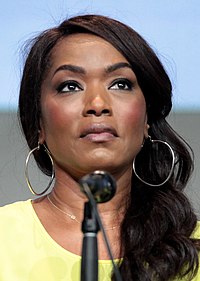
Laurence Fishburne and Angela Bassett were the protagonists of the moving picture forth with Keke Palmer. Both Fishburne and Bassett were attracted past its history; Fishburne said he was "really moved by it", and Bassett "just loved" it.[5] [vi]
- Keke Palmer every bit Akeelah Anderson:
- Three hundred girls auditioned for the office of Akeelah in Los Angeles, New York and Atlanta,[vii] with Palmer having auditioned five times to get the office.[viii] [nine] Atchison liked Palmer'south interim, simply the major gene in choosing her was the fact that at only age ten Palmer already had a profound interpretation of the script.[ix] He chose her as he did non want a child whom he would control but instead someone with whom he could have a collaboration: someone who would sympathize the role and "would make this character her own."[10] He merely assisted her to fully ensure that she would understand the character's feelings and would make "the correct emotional choices."[11]
- Laurence Fishburne as Dr. Joshua Larabee:
- Fishburne was pleased by the concept of the pic, stating he was "actually moved by it", and then that he accepted to take his part "at an affordable rate", according to producer Michael Romersa.[5] He kickoff read the script in 2002 and moved by the fact that "there were very few people with the courage" to "brand this kind of movie"[b] he besides accepted to exist a producer for the film.[14] About the character, Atchison said that Larabee is "vulnerable" and "a very sensitive guy" that has "a quiet moral authority".[fifteen] He also asserted that Fishburne made Larabee "a fairly buttoned-up, stoic type" and "subtly more animated" than how he envisioned the graphic symbol.[sixteen] Larabee is based upon a teacher, Robert Larabell, Atchison had in Phoenix, Arizona.[14] [17]
- Angela Bassett as Tanya Anderson:
- Bassett's agent sent her the script which she "merely loved."[6] [18] Atchison praised Bassett'south portrayal of the character, asserting she "made Tanya a real person" after understanding "the thought process of the character".[five] The director said Tanya wants the best for Akeelah only is reticent considering she thinks "the dream will fail and make things worse."[19] Bassett stressed that her character has to handle the pain of her hubby's death in improver to having bills paid[xviii] but that Tanya "gain[southward] some measure of courage herself" inspired past Akeelah.[6]
- Curtis Armstrong as Bob Welch:
- Atchison pointed Armstrong "was the perfect choice for the school principal." Near his character part in the motion picture, he said, "Welch is very excitable and provides a lot of the comic relief in our story."[20]
- J.R. Villarreal as Javier Mendez:
- Villarreal was called by scouts at the Sheraton Hotel in south McAllen to go to the next phase in Dallas.[21] After doing well in Dallas, he was sent to auditions in California and finally got the part.[22] He commented that "Javier is a very skillful friend to Akeelah ... And besides like his charisma, his character, he can e'er put a smile on your face up. He really doesn't intendance what people think of him that much and he helps Akeelah out with that petty matter because she cares very much what people think about her."[23]
- Sean Michael Afable as Dylan Chiu:
- Afable argued that his character can be "sometimes harsh and seemingly cutthroat", but this is because of the pressure level his father puts on him, noting Dylan's "truthful character" is seen at the end of the film.[24]
- Sahara Garey equally Georgia Carver
- Garey did "about six auditions" to take the role.[25] She commented that most her character: "she encourages Akeelah, because she sees so many qualities in her that she doesn't remember she herself has. Georgia aims lower, only she encourages Akeelah to aim higher."[26]
Erica Hubbard, Lee Thompson Young, and Julito McCullum portray Akeelah'southward sis and brothers Kiana, Devon, and Terrence, respectively.[27] Dalia Phillips appears equally Akeelah'south teacher, Ms. Cross,[27] [1] and Eddie Steeples as Derrick T.[27] Tzi Ma takes the role of Mr. Chiu, Dylan's male parent,[27] [i] while Wolfgang Bodison plays Tanya'south unnamed husband.[27]
Production [edit]
Writing [edit]
Doug Atchison first had the idea of making a film about spelling bees afterward watching the Scripps National Spelling Bee of 1994 and noticing that most of the contestants had "privileged backgrounds".[28] Atchison too considered spelling bees to comprise "all the drama and tension and entertainment value of a sporting effect", and felt that this could exist made into a flick.[29] [30] From this, he got the idea to write a script following the story of a child who had talent for spelling bee but was from a depression-income neighborhood and then did not "have access to the resource or coaching to pursue it equally these other kids had."[11] [28] He had the desire of making a "Rocky-like story" and although made it a "dramatic" plot, he declared it is "essentially a sports movie".[11]
Atchison started his screenplay in 1999, when he wrote a five-page treatment in nigh a month.[28] [29] In addition to the fact he was working on other projects, Atchison said he waited years before starting to write because he "idea someone else would do it start." This did non happen, so he began to write by himself.[30] Few changes were made in the process of transitioning from the original draft to the final production. One change was that at get-go, Akeelah's female parent had a smaller role and Akeelah's male parent was alive. Also, Larabee had been an older man (72 years old), and a few characters were cut. However, Atchison has summarized that "the steps she goes through, the friends she's got, those were always the same."[29]
Development [edit]
In 2000, Atchison submitted his script to the Academy of Motion Moving-picture show Arts and Sciences along with about 4,500 others, in hopes of winning the Nicholl Fellowships in Screenwriting. Atchison'southward script concluded upwardly being i of v scripts selected, and he won the grant.[28] [31] Editor Glenn Farr, then a member of the committee, offered to edit Atchison's film every bit before long as information technology was finished.[xvi] Producer Sid Ganis was also attracted to the story during the award presentation ceremony.[28] Nancy Hult Ganis, Sid'due south wife who was interested in public pedagogy, encouraged him to follow through with the film.[7]
The film was produced by Lionsgate Films, 2929 Entertainment, Starbucks Entertainment, Out of the Bluish Entertainment, Reactor Films and Movie house Gypsy Productions,[a] with a upkeep around $six–eight million.[three] [4] Still, the Ganis couple plant information technology difficult to secure funding for the picture.[7] In August 2001, Danny Llewelyn's Panoptic Pictures acquired the rights of Atchison's script.[32] In 2002, documentary Spellbound was released and attracted attention to spelling bees, which, co-ordinate to Hult Ganis, "helped u.s. in some style".[7] In November 2004, Lionsgate Films announced they would fund and distribute the film;[33] and in collaboration with 2929 Amusement they would co-finance the product.[34] In Jan 2006, Starbucks announced a partnership with Lionsgate to marketplace it.[35]
Another factor in non having a studio attached earlier was Atchison'southward desire to direct it as he wanted to ensure his story would remain the one he envisioned. Several studios wanted to turn Larabee'southward character into a white character simply Atchison felt "it was important that Akeelah'southward mentor be someone that comes from her neighborhood, that looks like her."[11] Lionsgate's President of Product Michael Paseornek agreed that Atchison should direct the script, claiming that he was the only person who could exercise information technology because the story "was in his centre and in his mind".[seven]
Filming [edit]
Filming began in Feb 2005;[36] the crew filmed for ten hours a solar day for thirty-one days.[20] [29] The eleven-year-old Palmer had to follow the United States' child labor laws, which necessitated spending at least 3 hours a day at school, i on recreation, and one at luncheon.[20] [29] Even so, Palmer appeared in almost every scene, well-nigh which Ganis commented, "I honestly don't know how nosotros figured it out, just we did".[20] To get the filming done on time, Atchison storyboarded the scenes alee of time and chatted with cinematographer David Mullen, the product designer Warren Immature, and Glenn Farr to compile a list of scenes.[29] This way, the filming team began each day knowing what shots they would take, their order, and the performances scheduled for each twenty-four hours.[20] [29] Most of the filming took place in South Los Angeles,[20] which Atchison picked as the filming location due to their depression upkeep.[9] Scenes were besides filmed at the University of Southern California, Hollywood Palladium—which stood in for the Grand Ballroom of the Washington, D.C. Hyatt Hotel—and Venice High School.[37]
Authenticity [edit]
To bring authenticity to the moving picture's portrayal of spelling bees, George Hornedo, who competed in spelling bees in real life, was hired to play contestant Roman and be "an unofficial technical consultant." Hornedo helped the actors to recreate "certain habits and idiosyncrasies they practice on stage to help them spell."[37] Thus, Akeelah skipping rope to memorize the words was added as "something that was normal for the spelling bee" but Atchison tried to create information technology in a "subtle" way as he thought the audience could consider this unrealistic.[38] Hornedo and other children who had never acted before were cast considering of their authentic portrayals of nervous contestants; other kids, in Atchison's eyes, were "too former in how they acted".[thirty] Likewise, Jacques Bailly, who won the Scripps National Spelling Bee in 1980 and is currently the contest's official pronouncer, since 2003, played himself in the film.[39]
To farther help the staff, Atchison asked Paige Kimball, director of the Scripps National Spelling Bee, to be a consultant. Kimball "was amazed at not but at how precise information technology was in its recreation, but besides how accurate the individuals and the casting for the event was."[37] However, she and the organization did accept some disagreements. Atchison has admitted that he originally created a more dramatic story than she wanted. Yet, he believed most of the disagreements were about technical procedures, "things you wouldn't even notice". For example, the children were originally sponsored by newspapers to compete, merely Atchison felt this detail did not amend the story, so he removed information technology. There were some concerns nigh the screenplay, and Atchison changed some of them "because [he] idea it didn't matter ane way or another and so [he] simply made them happy."[29]
Music [edit]
The pic features a musical score past Aaron Zigman, who wrote 45 minutes of compositions in 2 and a half weeks. He had planned to score Akeelah and the Bee over the holidays, only Lionsgate pushed its release appointment up, so Zigman was pressed for time to write the score.[40] He drew inspiration from Fishburne's performance to write it.[41] A soundtrack album consisting of 16 tracks was released by Lionsgate Records in a deal with BMG's Carmine Distribution on April 4, 2006.[42] [43] Information technology peaked at number 193 on the Billboard 200, and reached the 19th and 6th spot on the Billboard Top Independent Albums and Top Soundtracks respectively.[44] The original score, consisting of 37 tracks, was also released on Apr iv as an iTunes exclusive.[45] [46]
Themes and analysis [edit]
If you come across African-American kids striving to do something in the movies, information technology's sports or singing or dancing. Here, nosotros're engaging kids on their intellect. That, y'all don't see. These lies about black inferiority have been seeping into cinema, and that seeps into our kids. As a filmmaker, y'all can dig into these issues
—Doug Atchison[iii]
Commentators on Akeelah and the Bee opined information technology dealt with multiple themes, including race[47] and racism,[48] poverty,[49] educational organisation,[50] [51] competition and sportsmanship,[51] [52] self-esteem,[53] self-image,[54] stigma,[fifty] community,[50] [55] friendship,[56] gender[47] and sexism,[49] age,[47] grade[57] and classism,[48] and empowerment.[l] Atchison affirmed that its focus is not the spelling but "a kid who learns what she'south good at, becomes proud of that and doesn't want to hibernate it anymore. It's overcoming the fear of being great, earlier you can exist slap-up."[58] Sid Ganis described it as a film "nigh hope and doing great things against all the odds,"[7] while a New York Printing reviewer declared it "addresses the human condition".[57]
Later on attending USC Schoolhouse of Cinematic Arts and working at a youth center in South Los Angeles,[29] Atchison incorporated his experiences from the neighborhood into the film; among them, he heard that children who do well in school are said to be "interim white". As a effect, Atchison tried to utilize the motion picture to evidence what causes these children to doubt their own abilities.[30] These doubts are shown through the preconceptions Akeelah and other community members have that "Spelling Bee is for someone else".[34] She "must outset overcome her feelings of inadequacy,"[34] and when she discovers Larabee comes from her neighborhood and is a successful human, information technology "empowers her to ... accomplish this task."[vii] Fishburne stated the film's handling of race extends beyond the dichotomy of struggle and success, and goes into the prejudice that many people hold confronting black people competing in mainstream gild. Atchison elaborated, "it's about this girl'south insecurity about doing a matter that she hasn't seen people who expect similar her doing".[3] The director affirmed that African-American children in film usually aspire to nothing other than existence successful in sports, music or dance. He argued that the moving-picture show industry has disseminated "lies most black inferiority", so he was interested in focusing on their intellect rather than let them succumb to the stereotypes. Atchison noted he had created the project for all audiences "but especially for kids of colour to run across a little black girl who does something powerful."[three]
The manager as well attributed Akeelah's low-esteem and doubtfulness of her own capacities to the public school system, where she is bullied and "her intellectual marvel is kind of crushed".[11] Every bit such, Akeelah is portrayed as an "undermotivated student",[1] who "[u]nwilling to be stigmatized equally a freak or a brainiac," avoids showing her abilities.[50] According to Wesley Morris of The Boston Globe, the film shows "the contradiction gifted students feel in an inhospitable surroundings."[59] Ann Hornaday from The Washington Mail opined that Akeelah's sentence "Why would I want to represent a school that doesn't even take doors on the toilets?" is "one of the motion picture's many subtle critiques of the country'southward education policies."[55] Writing in the English Journal, Amanda Fifty. Hodges said information technology suggests a new approach on didactics with the "50,000 coaches" part; she declared it deconstructs the prototype of teachers "as those who keep order and disseminate noesis" and shows that "[t]eaching is not an isolated action that begins and ends at the classroom door."[60]
Villarreal commented that the picture show "teaches yous not to let your friends downwardly",[56] while Fishburne and Hornaday highlighted its theme of community.[5] [55] Marrit Ingman of The Austin Chronicle said the picture show indicates "a community-based, cooperative model of group success,"[51] while Justin Chang of Variety said it "focuses ... on the bee'southward community-uniting bear on."[ane] Hodges said Akeelah goes to the spelling bee because she recognizes it "proves that someone from their neighborhood can achieve success, and her achievement is, in a real sense, their own".[sixty] In contrast, Bernard Brook wrote for Multicultural Perspectives that it depicts "the success of individual perseverance",[61] while Red Feather Journall 'south Kathryn Linder expressed a like opinion about individual success.[62] However, Kenneth Turan of the Los Angeles Times commented "information technology raises important points about the ... obstacles to success that kids from poor neighborhoods face."[50] The New York Press 's reviewer went further and said social form was its "existent subject" equally information technology "depicts the basics of class mobility that are routinely taken for granted".[57] Nevertheless, Chang asserted it shows the spelling bee contest as "a democratizing force",[1] while Rob Asghar, for The Seattle Times, wrote it treats English equally "the quintessential American tool for success."[63]
Both Fishburne and Bassett likewise remarked that an important message of Akeelah and the Bee is to "speak properly" rather than strictly in vernacular, although Bassett emphasized the importance of the film's themes beyond spelling and spelling bees.[xiv] [18] Atchison added that beyond learning how to spell words, Akeelah must learn the importance of the words. He said that Larabee "looks at Akeelah as a potential leader. He wants her to sympathize her history. She needs to know the importance of language – and competition."[30] In spite of knowing its importance, it "deconstruct[s] the 'contest' paradigm of learning", according to Ingman.[51] Fishburne noted not merely children but parents can learn from the film; in his stance, the near important is that they should pay attention to their children's abilities.[14] Villarreal also felt that, through Dylan's father, parents would be able to ponder if they are "push[ing] their kids to follow their ain dreams and not the children's dreams."[23]
Release and reception [edit]
Marketing and release [edit]
The film was promoted past java shop chain Starbucks as a result of a partnership betwixt Lions Gate Entertainment and Starbucks Entertainment.[64] In January 2006, approximately eight,300 Starbucks locations in the United States and Canada began a promotional campaign for the flick involving spelling-related trivia games and promotions on cardboard cup sleeves.[35] [65] Diverseness stated that Lionsgate spent around $xx million with its market place only,[66] while Los Angeles Times reported a $25-1000000 price to both produce and market the film.[67] Ford Motor Company also sponsored the film by providing a Lincoln Zephyr to chauffeur the cast and creators to and from a screening.[68]
Akeelah and the Bee was first shown at the 2006 ShoWest on March 14,[69] and later premiered as the opening picture show at the 30th Cleveland International Film Festival on March 16.[seventy] On April 20, the pic was screened at The University of Motion Picture Arts and Sciences in Beverly Hills,[68] and it had a sneak preview in 900 theaters on April 22.[64] [71] With predictions of strong box-office returns by pic critics,[64] [72] it was released nationwide in theaters on April 28, grossing $6,011,585 in its opening weekend from around two,195 American theaters and ranking eighth at the box office.[iv] The film closed its run on July xiv and 20 domestically and internationally respectively, with $18,848,430 domestically and $110,994 internationally.[4] While the film received positive reviews, critics noted that it was not doing besides financially equally they had predicted,[73] [74] and Lionsgate's Michael Burns characterized the moving picture's gross with the word "simply".[75]
Outside the United States, the flick debuted at the Sprockets Toronto International Picture show Festival for Children on Apr 23, 2006,[76] where it was elected the all-time film by the kids in the ages of 10 and xi.[77] In the United Kingdom, Akeelah and the Bee was showtime shown at the Cambridge Film Festival on July 7,[78] and it premiered in the British theaters on August 18.[79] [eighty] The moving-picture show was also screened in Oct 2006 at the Rome Film Festival, in which it competed at the Alicy in the City section.[81]
Home media [edit]
The moving picture was released on DVD by Lionsgate Home Amusement on Baronial 29, 2006, becoming the first DVD offered for sale at Starbucks.[82] Its bonus features on the single-disc DVD include seven deleted scenes and a 25-minute making-of video featuring Atchinson and the cast.[83] DVD sales in the United States reached $5,391,947 every bit 317,942 copies were sold subsequently one week on sale. Past Dec 2006, American consumers had spent a total of $25,855,396 to purchase 1,512,498 copies,[84] making it one of the three virtually profitable home video releases of Lionsgate in 2006.[85]
Critical reaction [edit]

The moving picture received more often than not positive reviews from film critics. The review aggregator website Rotten Tomatoes reports an 85% blessing rating based on 141 reviews, with an boilerplate rating of seven.1/10. The site's disquisitional consensus reads, "A warm, family-friendly underdog story, featuring terrific supporting performances from Keke Palmer, Laurence Fishburne, and Angela Bassett".[91] On Metacritic, the film has an average weighted score of 72 out 100, based on 30 critics, indicating "generally favorable reviews".[92] CinemaScore reported that audiences gave the film a rare[93] average grade of "A+"—a feat merely 52 films reached betwixt 1982 and 2011.[94] National Board of Review elected it among the best ten independent films produced in 2006.[95] Additionally, two film critics, Chris Kaltenbach of The Baltimore Sun and Carrie Rickey of The Philadelphia Inquirer, added the film on their list of the ten best films of the year.[96] [97] St. Petersburg Times 's Steve Persall elected it the all-time family film of 2006.[98] African American Literature Book Lodge elected it as the all-time black film of 2006, every bit well as chose Fishburne as the second best actor, and Palmer and Basset as the second and eighth best actresses, respectively.[99]
Roger Ebert of the Chicago Dominicus-Times wrote it is "an uncommonly expert flick, entertaining and actually inspirational".[52] Writing for Film Journal International, Doris Toumarkine praised its pace and how "Atchison takes spelling competitions and conveys the excitement of the 'sport,' the appeal of the 'game,' the thrill of the win, [and] the burdensome blow of the loss".[100] Hornaday from The Washington Post called the film "a triumph on many levels" and peculiarly appreciated that S Los Angeles was presented without stereotypes.[55] Jane Clifford of U-T San Diego felt the film would appeal to both children and adults, and stated that every time she tried to predict its plot "it took a sharp plow. A turn that leaves you facing your stereotypes and feeling a petty sheepish".[56] Dana Stevens, writing for The New York Times, asserted, "The innate suspense and charm of the spelling bee", and "a trio of fissure performances" can turn "a formulaic sports picture" into a "tale that manages to inspire without being sappy".[101] Shantayaé Grant of The Jamaica Observer wrote that "interim is spectacular, the emotions are real and this story of black triumph is simply phenomenal".[102] A New York Press critic affirmed that Akeelah and the Bee "resurrects a most lost idea of what an art-moving-picture show actually is" because it has "dramatic attention to character and place, psychology and beingness".[57]
Chang of Variety commented that it "plays similar The Karate Kid with a pro-literacy agenda, pushing all the right emotional buttons still hitting quite a few incorrect ones in the process".[1] The Evening Relate 'due south review said it "conceals few narrative surprises" but contended that Atchison is likewise able to "defy our expectations".[103] Turan of the Los Angeles Times criticized that the film "telegraphs its plot"; nevertheless, he praised it as "genuinely sweet and determinedly inspirational".[50] PopMatters 's Cynthia Fuchs stated it is formulaic as it has some "conventions that brand then many other genre films feel stale", but that it "torques them slightly", emphasizing the "intellectual activities" Akeelah gets involved with.[104] Furthermore, the film was described as "derivatively entertaining in a feel-expert sort of manner" by Rick Groen in an article for The Globe and Mail.[105] Ingman of The Austin Chronicle described it equally a typical sports film and felt information technology was heavy-handed at times. However, she praised it for its themes and called the motion picture a "[t]houghtful, engaging" one and said it has a "cross-gender appeal".[51] Morris of The Boston Earth argued, "If Akeelah and the Bee is a generic, well-oiled commercial contraption, information technology is the first to credibly dramatize the plight of a truly gifted, poor black child". Morris added, "Obviously, it'south emotional propaganda. Simply it's merely the kind of propaganda our children need".[59]
Despite being a "critically-acclaimed" film, according to Rotten Tomatoes,[91] not all of its reviews were this positive. Anna Smith of Empire called it "formulaic and all-American", commenting that many scenes "appear functional rather than inspirational", and that the movie focused on the racial issue "a little too heavily". Smith stated, "clunky plotting and characterisation mean information technology has 'telemovie' written all over it".[106] Marc Mohan from The Oregonian stressed it tin be compared to subsequently-school specials due to its "lack of originality in plot and grapheme".[107] Time Out 's Jessica Wintertime also drew a comparation to after-school specials, proverb "on the big screen ... its clichés seem bigger and its characterisations broader than they would on the more forgiving telly".[108] Nick Schager of Camber Magazine lamented that the "clichés are besides numerous to mention",[109] while Neil Smith from BBC asserted it has "as much ... fantasy as Lord of the Rings".[79] January Stuart of Newsday deemed it "near suspense-free",[110] while Robert Hanks of The Independent stated it has an of import message but that is a "shame it couldn't be encased in a less faked-up story".[54] Commenting on The Times, Chris Ayres stressed that although it has skilful "visual flair" it "is ruined by its Oprah-style emotional manipulation".[111] New York Post 's Kyle Smith deemed it as "uplifting but unimaginative", suggesting that "Akeelah and the Bee is so warm and well-meaning that you lot may discover yourself wanting to like it more than y'all really practise".[112]
In spite of criticism, bandage members' performances were usually well received; in particular, Palmer's portrayal of Akeelah. Ebert said, "The movie depends on her, and she deserves its trust".[52] Hornaday opined that "Palmer's Akeelah is that cinematic rara avis, the child who is cute without being too cute, sympathetic without being cloying, and believable without existence deadening".[55] Evening Chronicle stated Palmer does it "with effortless grace" and that she "carries the motion-picture show and doesn't strike a unmarried wrong emotional annotation".[103] Fuchs felt that nearly of the film'due south strengths "have to do with Palmer'due south winning performance".[104] Ingman alleged Atchison'due south "ensemble is wonderful, and his star, Palmer, is a fantastically assured young actress who conveys Akeelah'south maelstrom of 11-year-onetime feelings with no apparent endeavour".[51] Turan complimented how Fishburne and Bassett'southward "presence and ability requite this film a welcome integrity".[fifty] Mohan stated, "Although Fishburne and Bassett can do these roles in their sleep, the kids are actually quite engaging".[107] Tourmakine felt there were "fine performances all effectually" and that Fishburne and Bassett "lend fine support in utterly believable roles".[100]
Racial issues [edit]
Chang called Dylan's begetter "a stiff Asian stereotype",[i] while Mohan of The Oregonian constitute it contradictory for an anti-racist picture show to contain such depiction.[107] Peter Bradshaw of The Guardian even claimed that the line "If you can barely beat a little black girl" (spoken past Dylan's father) signifies that Atchison "thinks it's all right to bring in racism past making the Asians the racists".[113] Metro Silicon Valley 's Richard von Busack commented that "[s]tepping effectually black stereotypes, the film squishes its two left feet right in the mire of Asian stereotyping".[114] Beth Accomando of KPBS likewise criticized Dylan and his male parent's portrayal as "painful cliches",[eleven] while Schager of Slant Magazine found it not authentic, even likening Dylan'due south father "dictatorial" way to Mao Zedong.[109]
Scholars Charise Pimentel and Cathleen Sawyer from the Texas State Academy published an article titled "Akeelah and the Bee: Inspirational Story of African-American Intellect and Triumph or Racist Rhetoric Served Up On Another Platter?" on the May 2011 issue of periodical Multicultural Perspectives.[115] On a critical discourse analysis, the authors contend that despite actualization to be an "innocent enough" movie, information technology has major approaches that brand it racist.[115] First, it implies that African-Americans need to be rescued by others;[115] second, depicts African-American communities every bit "marked by homelessness, poverty, criminality, unemployment, and remnants of gang action";[116] third, indicates that black people usually merely achieve success through sports by "linking the very essence of Akeelah's astounding power to spell to her rhythmic abilities";[117] and shows that African-Americans simply can succeed outside their communities, "far from the oppressive clutches of their own".[118]
Linder, on her September 2011 paper "Spelling Out Racial Difference: Moving Beyond the Inspirational Discourses in Akeelah and the Bee", also criticized it saying the film "acts as a platform for a racial melodrama through which ideals of whiteness are reinforced and strengthened".[119] Using Linda Williams' categories of what constitutes a racial melodrama, Linder argues that it is described equally an "inspirational" film because of "[its] portrayal of Akeelah's victimization by the black community that surrounds her" and of redemption only achieved "through the idealized soapbox of young people's educational success as divers by dominant (white) culture".[120] Linder said characters "are mostly represented every bit having 'no involvement in escape' from societal oppressions and limitations" and that "there is no sign throughout the picture show of any kind of lasting change for Akeelah'southward school or her young peers".[121]
Linder affirms that information technology creates a dichotomy between "success (whiteness) versus failure (blackness)".[121] Pimentel and Sawyer, also equally Linder, identify Larabee equally the one who makes this separation clear when he manifests his disregard of African American Vernacular English language.[122] [116] The co-authors wrote that Larabee implies that "legitimate forms of intelligence can but be achieved through a Eurocentric perspective, thus advancing the message that Akeelah must exist rescued from her African-American means of knowing, in order to be considered intellectual".[116] Some other contraposition commented by scholars was "between the supportive Dr. Larabee and Akeelah's skeptical mother".[123] Pimental and Sawyer said she is portrayed as "an African-American obstructionist",[124] while scholar Gloria Ladson‐Billings asserted she represents the stereotype of "ignorant Black woman".[125] Although Fuchs said the motion-picture show was able to avoid the "white authority effigy saves the underclass child" plotline past introducing Larabee,[104] Ladson‐Billings, Linder, and Pimentel and Sawyer opined that it did non.[124] [125] Later all, Larabee, as Linder described, is "a non-threatening black man who has alloyed to white culture and who can be depended on to help assimilate others".[121]
Accolades [edit]
The film was nominated for six Black Reel Awards, winning simply Best Actress for Palmer.[88] [126] Out of five NAACP Prototype Awards nominations, Akeelah and the Bee won Outstanding Actress in a Motion Film and Outstanding Writing in a Feature Picture/Television Movie – Comedy or Drama.[89] [127] At the Blackness Motion-picture show Awards, it won the five awards it was nominated for.[87] The same happened during the Young Artist Awards where it was nominated for two categories and won two awards,[xc] and at the CAMIE Awards where it was nominated for and won an award.[128] The flick was as well nominated for but did not win any honour from the BET Awards,[129] [130] Broadcast Film Critics Clan Awards,[131] Chicago Pic Critics,[132] [133] and Satellite Awards.[134] [135]
| Award | Category | Recipients[c] | Result |
|---|---|---|---|
| BET Awards[129] [130] | All-time Actress | Angela Bassett | Nominated |
| Black Motion picture Awards[87] | Outstanding Move Film | Won | |
| Outstanding Actress in a Motion picture | Keke Palmer | ||
| Outstanding Supporting Histrion in a Movement Picture | Laurence Fishburne | ||
| Outstanding Supporting Extra in a Motion Picture | Angela Bassett | ||
| Blackness Reel Awards[88] [126] | Best Moving-picture show | Nominated | |
| Best Actress | Keke Palmer | Won | |
| All-time Supporting Extra | Angela Bassett | Nominated | |
| Best Supporting Thespian | Laurence Fishburne | ||
| Best Original Score | Aaron Zigman | ||
| Best Breakthrough Functioning | Keke Palmer | ||
| Circulate Pic Critics Association Awards[131] | Best Family Picture show (Live Action) | ||
| Best Younger Extra | Keke Palmer | ||
| CAMIE Awards[128] [136] | CAMIE Laurels | Sean Michael Afable | Won |
| Chicago Film Critics[132] [133] | Most Promising Newcomer | Keke Palmer | Nominated |
| NAACP Image Award[89] [127] | Outstanding Motion Picture | ||
| Outstanding Extra in a Motility Picture show | Keke Palmer | Won | |
| Outstanding Supporting Actress in a Motion Picture | Angela Bassett | Nominated | |
| Outstanding Supporting Actor in a Movement Picture | Laurence Fishburne | ||
| Outstanding Writing in a Feature Film/Goggle box Motion-picture show – Comedy or Drama | Doug Atchison | Won | |
| Satellite Awards[134] [135] | Outstanding Youth DVD | Nominated | |
| Young Artist Awards[90] | Best Performance in a Characteristic Film – Leading Young Extra | Keke Palmer | Won |
| All-time Family Feature Film (Drama) |
Notes [edit]
- ^ a b The credits for the film reads "A Lionsgate, 2929 Productions and Starbucks Amusement presentation of an Out of the Blue and Reactor Films production in association with Cinema Gypsy Productions."[1] [two]
- ^ By "this kind of movie", Fishburne was saying that Akeelah and the Bee breaks upward with common stereotypes of African Americans reinforced by media. He declared, "There are no gangsters in it; there are no rappers in it. Studios are looking for an like shooting fish in a barrel manner to make money; [with black films], information technology's comedy, or it's action, or information technology's 'ghetto fabulous.'"[12] According to him, Hollywood "doesn't care virtually a young, disadvantaged black girl."[13]
- ^ When this space is blank it indicates that the moving picture itself was the recipient.
References [edit]
- ^ a b c d e f one thousand h Chang, Justin (March 20, 2006). "Review: 'Akeelah and the Bee'". Variety. Archived from the original on July 23, 2015. Retrieved July 21, 2015.
- ^ Production 2006, p. 4.
- ^ a b c d e Hayes, John (April 30, 2006). "Fishburne says 'Akeelah' touches on risky themes". Pittsburgh Post-Gazette. Cake Communications. Archived from the original on July 14, 2014. Retrieved June 20, 2014.
- ^ a b c d e "Akeelah and the Bee". The Numbers. Nash Data Services. Archived from the original on December 16, 2013. Retrieved May 10, 2014.
- ^ a b c d Production 2006, p. 8.
- ^ a b c Morales, Wilson (April 2006). "Akeelah and the Bee: An Interview with Angela Bassett". BlackFilm.com. Archived from the original on September 23, 2015. Retrieved June 20, 2014.
- ^ a b c d e f one thousand Production 2006, p. 6.
- ^ Berkes, Howard (May 6, 2006). "Keke Palmer on Bee-ing 'Akeelah'". NPR. Archived from the original on July 29, 2014. Retrieved June 21, 2014.
- ^ a b c Lee, Michael J. (April 1, 2006). "Doug Atchison on 'Akeelah and the Bee'". RadioFree.com. Archived from the original on July 29, 2014. Retrieved June 21, 2014.
- ^ Production 2006, p. 7.
- ^ a b c d e f Accomando, Beth (May 4, 2006). "Akeelah and the Bee". KPBS. Archived from the original on September 11, 2015. Retrieved July 21, 2015.
- ^ "ShoWest 2006 Distinguished Decade of Accomplishment in Film". The Hollywood Reporter. Prometheus Global Media. March 16, 2006. Archived from the original on July 26, 2015. Retrieved July 20, 2015.
- ^ "Black Enterprise Profiles Hollywood'south New Hotshots". PR Newswire. Nov 21, 2006. Archived from the original on July 22, 2015. Retrieved July 21, 2015.
- ^ a b c d Lee, Michael J. (April i, 2006). "Laurence Fishburne on 'Akeelah and the Bee'". RadioFree.com. Archived from the original on July 29, 2014. Retrieved June 20, 2014.
- ^ Production 2006, pp. 7–8.
- ^ a b Anderson, Jeffrey M. (April 13, 2006). "Interview with Laurence Fishburne". Combustible Celluloid. Archived from the original on Nov 18, 2014. Retrieved June xx, 2014.
- ^ Mercer, Brandon (May 2, 2014). "#ThankATeacher Trending Before National Teacher Day On May 6th". CBS San Francisco. Archived from the original on May 19, 2014. Retrieved June twenty, 2014.
- ^ a b c Murray, Rebecca (2006). "Angela Bassett Talks About 'Akeelah and the Bee'". About.com. Archived from the original on April 21, 2014. Retrieved June 17, 2014.
- ^ Production 2006, pp. 8–9.
- ^ a b c d e f Production 2006, p. 9.
- ^ Gonzalez, Sandra (August 12, 2009). "Mission actor, kid sis don't care who gets famous first". The Monitor. Archived from the original on July 22, 2015. Retrieved July 22, 2015.
- ^ "Mission Student Has Office In Major Picture show". Progress Times. May nineteen, 2006. Archived from the original on July 22, 2015. Retrieved July 22, 2015.
- ^ a b Murray, Rebecca (2006). "Interview with JR Villarreal from Akeelah and the Bee". Most.com. Archived from the original on February 21, 2014. Retrieved June 17, 2014.
- ^ "Interview with Sean Michael Afable". The Eerie Digest. October ane, 2010. Archived from the original on July 29, 2014. Retrieved June twenty, 2014.
- ^ "Sahara Garey Exclusive Interview". The Star Scoop. May 29, 2006. Archived from the original on July 8, 2015. Retrieved June twenty, 2014.
- ^ Williams, Kam (May i, 2006). "Sahara Garey: The Akeelah and the Bee Interview". DallasBlack.com. Archived from the original on July 8, 2015. Retrieved June twenty, 2014.
- ^ a b c d eastward Production 2006, p. 28.
- ^ a b c d e Product 2006, p. 5.
- ^ a b c d e f g h i Murray, Rebecca (2006). "Interview with 'Akeelah and the Bee' Writer/Director Doug Atchison". Well-nigh.com. pp. one–two. Archived from the original on Feb 26, 2014. Retrieved June 17, 2014.
- ^ a b c d eastward Stitt, Brian (April 7, 2006). "Akeelah and the Bee: An Interview with Doug Atchison". Student Life. Washington University in St. Louis. Archived from the original on November 29, 2014. Retrieved June xviii, 2014.
- ^ "Academy Nicholl Fellows 1986–Present". University of Movie Arts and Sciences. Archived from the original on March 2, 2009. Retrieved June 17, 2014.
- ^ Swanson, Tim (August 14, 2001). "Panoptic buzzes to 'Bee'". Variety. Penske Media Corporation. Archived from the original on March 5, 2016. Retrieved July 21, 2015.
- ^ Foreman, Liza (Nov 30, 2004). "Lions Gate Gets Busy on 'Bee' Drama". Backstage. Archived from the original on September 23, 2015. Retrieved July 21, 2015.
- ^ a b c Dunkley, Cathy (Nov 29, 2004). "Lions Gate puts 'Bee' in its bonnet". Variety. Penske Media Corporation. Archived from the original on July 23, 2015. Retrieved July 21, 2015.
- ^ a b Bloomberg News (January 13, 2006). "Starbucks to Add Motion picture Products". The New York Times. Archived from the original on July 8, 2014. Retrieved May 20, 2014.
- ^ Dunkley, Cathy (January 12, 2005). "Bassett on 'Bee' spree". Variety. Penske Media Corporation. Archived from the original on March v, 2016. Retrieved July 21, 2015.
- ^ a b c Production 2006, p. 10.
- ^ Murray, Rebecca (2006). "Keke Palmer Steals the Evidence in Akeelah and the Bee". About.com. Archived from the original on 2014-02-26. Retrieved June 17, 2014.
- ^ Stephey, One thousand.J. (May 26, 2009). "Spelling Bee Pronouncer Jacques Bailly". Time . Retrieved May 26, 2016.
- ^ Goldwasser, Dan (February 2007). "Aaron Zigman - Interview". Soundtrack.Cyberspace. Archived from the original on July 14, 2014. Retrieved June 21, 2014.
- ^ Tran, Kim. "An Interview With Aaron Zigman". In Magazine. Archived from the original on July 22, 2015. Retrieved June 21, 2014.
- ^ "Akeelah and the Bee Soundtrack (2006)". Soundtrack.Cyberspace. Archived from the original on July 29, 2014. Retrieved June 21, 2014.
- ^ Martens, Todd (April 15, 2006). "Lionsgate's New Tracks". Billboard. 118 (15): 22.
- ^ "Akeelah and the Bee [Original Soundtrack] - Original Soundtrack − Awards". AllMusic. Archived from the original on August 29, 2017. Retrieved June 21, 2014.
- ^ "Akeelah and the Bee - Original Score (2006)". Soundtrack.Internet. Archived from the original on July 29, 2014. Retrieved June 21, 2014.
- ^ Larson, Randall (May eighteen, 2007). "Lionsgate releases Tyler's BUG score online". Mania.com. Archived from the original on July 29, 2014. Retrieved June 21, 2014.
- ^ a b c Linder 2011, p. 18.
- ^ a b Gordon, Rachel (April 27, 2006). "Akeelah and the Bee". Filmcritic.com. Archived from the original on October 21, 2007. Retrieved August 1, 2015.
- ^ a b Niemiec & Wedding 2013, p. 65.
- ^ a b c d e f g h Turan, Kenneth (Apr 28, 2006). "Movie Review - 'Akeelah and the Bee'". Los Angeles Times. Archived from the original on August 29, 2006. Retrieved June 21, 2014.
- ^ a b c d due east f Ingman, Marrit (April 28, 2006). "Akeelah and the Bee". The Austin Chronicle. Archived from the original on July fourteen, 2014. Retrieved June 21, 2014.
- ^ a b c Ebert, Roger (April 27, 2006). "Akeelah and the Bee Review (2006)". rogerebert.com. Archived from the original on July eight, 2014. Retrieved May 16, 2011.
- ^ Linder 2011, p. 25-26.
- ^ a b Hanks, Robert (August 18, 2006). "Akeelah and the Bee (12A)". The Independent. Archived from the original on September 24, 2015. Retrieved August 1, 2015.
- ^ a b c d e Hornaday, Ann (April 28, 2006). "'Akeelah and the Bee': 1 Love of a Motion-picture show". The Washington Post. Nash Holdings. Archived from the original on July 16, 2014. Retrieved June 10, 2014.
- ^ a b c Clifford, Jane (April 29, 2006). "'Akeelah' a letter of the alphabet-perfect feel-practiced family movie". U-T San Diego. Copley Newspapers. Archived from the original on July fourteen, 2014. Retrieved June 21, 2014.
- ^ a b c d "Bee Season". New York Printing. Straus News. May 3, 2006. Archived from the original on March 7, 2016. Retrieved July 29, 2015.
- ^ Product 2006, p. 11.
- ^ a b Morris, Wesley (April 28, 2006). "In a discussion, 'Akeelah' spells crowd-pleaser". The Boston World. Boston Globe Media Partners. Archived from the original on July 15, 2014. Retrieved June 21, 2014.
- ^ a b Hodges, Amanda L. (January 2010). "A Critical Shut-Up: 3 Films and Their Lessons in Disquisitional Literacy". English Journal. National Council of Teachers of English. 99 (3): 73. JSTOR 40503486.
- ^ Beck 2009, p. 149.
- ^ Linder 2011, p. 24.
- ^ Ashgar, Rob (May 18, 2006). "One nation, i anthem, sung in our mutual tongue". The Seattle Times. Archived from the original on March 4, 2016. Retrieved August 1, 2015.
- ^ a b c Douglas, Edward (April 28, 2006). "Your Weekly Guide to New Movies for April 28, 2006". ComingSoon.net. CraveOnline. Archived from the original on June i, 2012. Retrieved May ten, 2014.
- ^ McClintock, Pamela (April three, 2006). "Inside Move: Grounds for 'Bee' blurbs". Diverseness. Penske Media Corporation. Archived from the original on July 23, 2015. Retrieved July 21, 2015.
- ^ Graser, Marc (August 23, 2007). "Crude offset for Starbucks". Variety. Penske Media Corporation. Archived from the original on May 12, 2014. Retrieved May 10, 2014.
- ^ Friedman, Josh; Munoz, Lorenza (Baronial 27, 2007). "Disappointing bean counters". Los Angeles Times. Archived from the original on May 12, 2014. Retrieved May 10, 2014.
- ^ a b "Lincoln Zephyr Rolls Out Blood-red Carpeting for Premiere of Lionsgate's 'Akeelah and the Bee'". PR Newswire. Apr 20, 2006. Archived from the original on July 22, 2015. Retrieved July 21, 2015.
- ^ "TI Highlights Advancement of Digital Cinema Manufacture at ShoWest". PR Newswire. March 13, 2006. Archived from the original on September 24, 2015. Retrieved July 21, 2015.
- ^ "30th Cleveland International Film Festival". Cleveland Magazine. Great Lakes Publishing. May 2006. Archived from the original on September 23, 2015. Retrieved July 21, 2015.
- ^ Strowbridge, C.S. (April 21, 2006). "Silencing the Critics". The Numbers. Nash Information Services. Archived from the original on May 12, 2014. Retrieved May 10, 2014.
- ^ Strowbridge, C.S. (April one, 2006). "2006 Preview: April". The Numbers. Nash Information Services. Archived from the original on July 2, 2012. Retrieved May 10, 2014.
- ^ "RV drives the US box office". Total Flick. Future Publishing. May 2, 2006. Archived from the original on May 12, 2014. Retrieved May 10, 2014.
- ^ Strowbridge, C.S. (May 10, 2006). "R.Five. Sticks it to Contest". The Numbers. Nash Data Services. Archived from the original on September 1, 2014. Retrieved May 10, 2014.
- ^ Holleran, Scott (April 23, 2008). "Interview: Lionsgate's Michael Burns". Box Office Mojo. Amazon.com. Archived from the original on May 12, 2014. Retrieved May ten, 2014.
- ^ "Schedule & Special Events". Toronto International Moving-picture show Festival Group. Archived from the original on Apr 23, 2006. Retrieved July 22, 2015.
- ^ Brooks, Brian (May i, 2006). ""Motility Your World" and "Renart the Flim-flam" Among Prize Winners at ninth Sprockets Toronto International Fi". IndieWire. SnagFilms. Archived from the original on July 22, 2015. Retrieved July 22, 2015.
- ^ "Akeelah and the Bee". Cambridge Motion picture Festival. Archived from the original on September 30, 2006. Retrieved July 22, 2015.
- ^ a b Smith, Neil (Baronial 14, 2006). "Akeelah and the Bee". BBC. Archived from the original on September 25, 2015. Retrieved June 21, 2014.
- ^ "Film review: Akeelah and the Bee (12A)". Manchester Evening News. Trinity Mirror. Apr 17, 2010. Archived from the original on July 22, 2015. Retrieved July 22, 2015.
- ^ Vivarelli, Nick (September 26, 2006). "Rome fest mixes flavors". Diverseness. Penske Media Corporation. Archived from the original on Baronial 29, 2017. Retrieved July 22, 2015.
- ^ Ault, Susanne (June two, 2006). "Starbucks rocks with Berry DVD". Video Business. Reed Business concern Data. Archived from the original on March 6, 2009. Retrieved Baronial 18, 2009.
- ^ Holleran, Scott (2006). "Film Review: Akeelah and the Bee". Box Function Mojo. Amazon.com. Archived from the original on July 14, 2014. Retrieved May x, 2014.
- ^ "Akeelah and the Bee – DVD Sales". The Numbers. Nash Data Services. Archived from the original on May 12, 2014. Retrieved May 10, 2014.
- ^ Vlessing, Etan (February 2, 2007). "Revenues boost Lionsgate Q3 earnings". The Hollywood Reporter. Prometheus Global Media. Archived from the original on July 26, 2015. Retrieved July twenty, 2015.
- ^ Macdonald, Moira (Apr 28, 2006). "Akeelah and the Bee": Young star casts quite a spell in busy, busy "Bee". The Seattle Times. Archived from the original on July 3, 2019. Retrieved June 21, 2014.
- ^ a b c "2006 Nominees and Winners". Black Picture Awards. Archived from the original on 2014-08-eleven. Retrieved May 31, 2014.
- ^ a b c "'Dreamgirls' Sweeps Blackness Reel Awards". World Entertainment News Network. February 7, 2007. Archived from the original on July 8, 2014. Retrieved July viii, 2014 – via HighBeam.
- ^ a b c "38th annual NAACP Image Awards winners". The states Today. Gannett Company. Associated Press. March 3, 2007. Archived from the original on July 29, 2014. Retrieved May 31, 2014.
- ^ a b c "28th Immature Artist Awards – Nominations / Special Award". Young Artist Honor. Archived from the original on March 31, 2014. Retrieved May 31, 2014.
- ^ a b "Akeelah and the Bee (2006)". Rotten Tomatoes. Flixster. Archived from the original on May 13, 2014. Retrieved Jan 11, 2022.
- ^ "Akeelah and the Bee". Metacritic. Retrieved May x, 2014.
- ^ "The Avengers Makes $80.5 Million Its Opening Day!". ComingSoon.cyberspace. CraveOnline. May 5, 2012. Archived from the original on May 7, 2012. Retrieved May five, 2012.
- ^ McClintock, Pamela (August 19, 2011). "Why CinemaScore Matters for Box Role". The Hollywood Reporter. Prometheus Global Media. Archived from the original on April 26, 2014. Retrieved May 10, 2014.
- ^ Goldstein, Gregg. "Board of Review votes 'Iwo Jima' best picture". The Hollywood Reporter. Prometheus Global Media. Archived from the original on July 26, 2015. Retrieved July 20, 2015.
- ^ Kaltenbach, Chris (December 29, 2006). "Chris Kaltenbach's Favorite Films". The Baltimore Lord's day. Tribune Publishing. Archived from the original on July 22, 2015. Retrieved May 23, 2015.
- ^ Rickey, Carrie (December 31, 2006). "2006 The Yr on Screen - As performers reclaimed the movies, give them an A for acting". The Philadelphia Inquirer. Philadelphia Media Network. Archived from the original on July 21, 2015. Retrieved May 23, 2015.
- ^ Persall, Steve (December 29, 2006). "For fans, a happy ending after all". Petrograd Times. Times Publishing Visitor. Archived from the original on March 4, 2016. Retrieved July 26, 2015.
- ^ Williams, Kam. "Blacktrospective 2006 Almanac Look Back at the Best (and Worst) in Black Cinema". AALBC.com . Retrieved January eleven, 2022.
- ^ a b Toumarkine, Doris (April 20, 2006). "Akeelah and the Bee". Film Periodical International. Prometheus Global Media. Archived from the original on July 14, 2014. Retrieved June ten, 2014.
- ^ Stevens, Dana (Apr 28, 2006). "A Immature Girl and Big Words in 'Akeelah and the Bee'". The New York Times. Archived from the original on May 7, 2006. Retrieved June 21, 2014.
- ^ "Blackness History in Movies". The Jamaica Observer. Feb 5, 2013. Archived from the original on Feb 14, 2013. Retrieved Baronial ii, 2015.
- ^ a b "Akeelah and the Bee". Evening Chronicle. August 18, 2006. Archived from the original on July fourteen, 2014. Retrieved June 10, 2014.
- ^ a b c Fuchs, Cynthia (April 28, 2006). "Akeelah and the Bee (2006)". PopMatters. Archived from the original on July xvi, 2014. Retrieved June 21, 2014.
- ^ Groen, Rick (April 28, 2006). "A star shines in a bee movie". The Globe and Mail service. CTVglobemedia. Archived from the original on February 4, 2008. Retrieved June 21, 2014.
- ^ Smith, Anna (March 26, 2007). "Akeelah And The Bee Review". Empire. Bauer Media Group. Archived from the original on October 6, 2014. Retrieved June 21, 2014.
- ^ a b c Mohan, Marc (April 28, 2006). "Akeelah and the B movie". The Oregonian. Archived from the original on Jan eleven, 2007. Retrieved June 21, 2014.
- ^ Winter, Jessica (August 17, 2006). "Akeelah and the Bee". Time Out. Archived from the original on July 14, 2014. Retrieved June 21, 2014.
- ^ a b Schager, Nick (Apr 21, 2006). "Film Review: Akeelah and the Bee". Camber Magazine. Archived from the original on Baronial four, 2007. Retrieved June 21, 2014.
- ^ Stuart, January (April 28, 2006). "Sting of defeat for 'Bee' is the plot". Newsday. Cablevision. Archived from the original on 2008-03-27. Retrieved August 1, 2015.
- ^ Ayres, Chris (August 17, 2006). "A spell of good fortune". The Times. News U.k.. pp. 18–xix (Times2 supplement).
- ^ Smith, Kyle (April 28, 2006). "Spelling Error". New York Post. News Corp. Archived from the original on July 15, 2014. Retrieved June 21, 2014.
- ^ Bradshaw, Peter (Baronial 18, 2006). "Akeelah and the Bee". The Guardian. Archived from the original on July 14, 2014. Retrieved June 21, 2014.
- ^ von Busack, Richard (April 26, 2006). "Casting a Spell". Metro Silicon Valley. Metro Newspapers. Archived from the original on March 5, 2016. Retrieved August i, 2015.
- ^ a b c Pimentel & Sawyer 2011, p. 100.
- ^ a b c Pimentel & Sawyer 2011, p. 101.
- ^ Pimentel & Sawyer 2011, p. 103.
- ^ Pimentel & Sawyer 2011, p. 104.
- ^ Linder 2011, p. xix.
- ^ Linder 2011, p. 22.
- ^ a b c Linder 2011, p. 30.
- ^ Linder 2011, p. 26.
- ^ Linder 2011, p. 28.
- ^ a b Pimentel & Sawyer 2011, p. 103-104.
- ^ a b Ladson‐Billings 2009, p. 93.
- ^ a b "Blackness Reel Award nominations". Arkansas Times. Arkansas Times Express. December 18, 2006. Archived from the original on July 14, 2014. Retrieved May 31, 2014.
- ^ a b "2007 Image Honor nominees and winners". The Hollywood Reporter. Prometheus Global Media. March 1, 2007. Archived from the original on July 26, 2015. Retrieved July 20, 2015.
- ^ a b Angels, Steve (February 14, 2013). "Fil-Am actor to visit the Philippines". ABS-CBN News. Archived from the original on May 3, 2013. Retrieved May 31, 2014.
- ^ a b Murray, Jawn (June 11, 2007). "Everybody Loves Tichina". Black Voices. AOL. Archived from the original on November 22, 2008. Retrieved May 31, 2014.
- ^ a b "Jennifer Hudson Snags Best New Artist and Best Extra Honors at BET Awards". Fox News Channel. June 27, 2007. Archived from the original on August 12, 2014. Retrieved May 31, 2014.
- ^ a b "2006 Nominees". Broadcast Film Critics Association Awards. Archived from the original on February 21, 2007. Retrieved May 31, 2014.
- ^ a b "This Year's Nominees". Chicago Film Critics. Archived from the original on July 24, 2007. Retrieved May 31, 2014.
- ^ a b "Winners Announced for the 2006 Chicago Film Critics Awards". Chicago Picture Critics. Archived from the original on July 24, 2007. Retrieved May 31, 2014.
- ^ a b "Satellite Awards nominations appear". Variety. Penske Media Corporation. December ane, 2006. Archived from the original on August 1, 2015. Retrieved Baronial 1, 2015.
- ^ a b Sneider, Jeff (December eighteen, 2006). "'Departed,' 'Dreamgirls' win at Satellite Awards". Variety. Penske Media Corporation. Archived from the original on March 5, 2016. Retrieved August 1, 2015.
- ^ "Congratulations 2007 CAMIE Winners!". CAMIE Awards. May 12, 2007. Archived from the original on July half-dozen, 2007. Retrieved May 31, 2014.
Works cited [edit]
- "Akeelah and the Bee Production Notes" (PDF). HollywoodJesus.com. Archived from the original (PDF) on May 7, 2013. Retrieved June 17, 2014.
- Beck, Bernard (2009). "Angels With Muddied Faces: Who Invited Slumdog Millionaire and The Visitor?". Multicultural Perspectives. 11 (iii): 146–149. doi:ten.1080/15210960903116589. S2CID 144128792.
- Ladson‐Billings, Gloria (2009). "'Who you callin' nappy‐headed?' A disquisitional race theory await at the construction of Black women". Race Ethnicity and Teaching. Routledge. 12 (i): 87–99. doi:x.1080/13613320802651012. S2CID 143448010.
- Linder, Kathryn (September 2011). "Spelling Out Racial Difference: Moving Beyond the Inspirational Discourses in Akeelah and the Bee" (PDF). Red Feather Journal. 2 (2): 18–33. Archived from the original (PDF) on 2016-03-04. Retrieved July 29, 2015.
- Niemiec, Ryan M; Wedding, Danny (2013). Positive Psychology at the Movies: Using Films to Build Virtues and Character Strengths. Hogrefe Publishing. ISBN978-i-61676-443-2.
- Pimentel, Charise; Sawyer, Cathleen (May 2011). "Akeelah and the Bee: Inspirational Story of African-American Intellect and Triumph or Racist Rhetoric Served Up On Some other Platter?". Multicultural Perspectives. National Association for Multicultural Didactics. 13 (2): 100–104. doi:ten.1080/15210960.2011.571559. S2CID 17731813.
External links [edit]
- Akeelah and the Bee at IMDb
- Akeelah and the Bee at AllMovie
- Akeelah and the Bee at Box Function Mojo
- Akeelah and the Bee at Metacritic
Source: https://en.wikipedia.org/wiki/Akeelah_and_the_Bee

Post a Comment for "Honey Lifetime Movie About Black Woman Saves White Baby Girl"