Photos French Louis Xiv Mirror With Hand Painting Art 18001900s
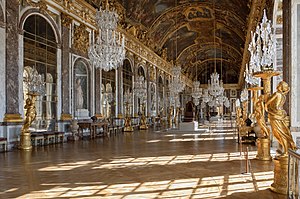
Hall of Mirrors, Palace of Versailles
The Hall of Mirrors (French: Grande Galerie, Galerie des Glaces, Galerie de Louis Fourteen) is a grand Baroque style gallery and one of the well-nigh emblematic rooms in the royal Palace of Versailles near Paris, France. The grandiose ensemble of the Hall and its adjoining salons was intended to illustrate the power of the absolutist monarch Louis XIV. Located on the first floor (pianoforte nobile) of the palace'south central trunk, information technology faces due west towards the Palace Gardens.[1] [two] The Hall of Mirrors has been the scene of events of dandy historic significance, including the Proclamation of the High german Empire and the signing of the Treaty of Versailles.
Cultural and historical background [edit]
Construction [edit]

The regal apartments next to the Hall of Mirrors
In 1623 King Louis Xiii ordered the construction of a modest ii-story hunting lodge at Versailles, which he shortly enlarged to a château from 1631 to 1634. His son Louis 14 declared the site his hereafter permanent residence in 1661 and ordered the transformation into an all-encompassing residence in several stages and on a grandiose scale. The palace was to provide platonic settings for residue and retreat just information technology also had to reach a new quality of representation as the time to come seat of Europe's greatest absolutist royal court and government of supreme dominance, residence of choice for the aristocratic lodge and arena for elaborate country festivals and ceremonies, Europe's centre of culture, art and amusement. During the early expansion stage Louis Le Vau added the Forecourt (1662) and the "Le Vau Envelope" (1668 to 1670), encased the old château and added 2 new wings in the n and south. The new wings towered over the original western building by the garden. The space in betwixt was a terrace supported past arcades. The buildings of the "Le Vau Envelope" included the king's apartments in the north and the queen'southward apartments in the south.[three]
The Hall of Mirrors was built during the third building stage between 1678 and 1684 and was to supervene upon a large terrace and several smaller salons facing the gardens. The terrace was originally situated direct outside of the Rex'due south and the Queen's apartments. The terrace was considered to be a rather misplaced architectural element and exposed to the elements, reducing its utility. Eventually it was decided to demolish information technology and architect Jules Hardouin-Mansart was tasked with the pattern development and the construction of the Mirror Hall Gallery and artist Charles Le Brun received the accolade to create the interior decorative appliance.[4] [5]
The garden facade of the Corps de logis was built in a straight front and essentially received its current appearance. The Hall of Mirrors is flanked at the far ends by the Salon of War (Salon de la guerre) in the due north and the Salon of Peace (Salon de la paix) in the southward, respectively. The Mirror Gallery connects to the two Salons, which were assigned to and incorporated into the king's apartments in the due north and the queen's apartments in the south. Both Salons are attainable via the Mirror Gallery through wide opening passageways. The Hall and the two Salons were identically furnished and decorated and grade a stylistic and functional unit. The exterior walls of the Salons date from the time of Le Vau's encasings of the old château and were given their current appearance after the installation of the Mirror Hall by Hardouin-Mansart.[6] [vii]
The Hall of Mirrors is—likewise the Palace Chapel, completed in the early 18th century, the Court Opera and the Galerie des Batailles—one of the largest rooms in the palace. It is 73 m (240 ft) long and 10.50 thou (34.4 ft) deep.[viii] With its superlative of 12.30 m (40.4 ft) information technology reaches to the Attic floor of the Corps de Logis. The foursquare windows on the upper floor, which can be seen from the exterior, only serve aesthetic purposes, as there are no rooms inside. The installation of any kind of fireplaces was never contemplated as the Hall of Mirrors was too big to effectively exist heated.[ix] [10]
Arts and decoration [edit]
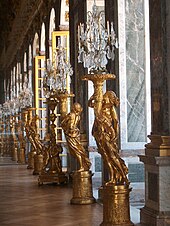
Sculptured Guéridons replaced the 1689 melted down argent furniture.
The Mirror Hall'southward 17 windows open in the direction of the park. On the opposite inside wall of the Hall are 17 equally large mirrors, that are composed of more than 350 individual mirror surfaces. On the one manus, the mirrors had an aesthetic function, as the mirror image of the garden depicted the outside of the castle into the interior of the edifice and reflected the candlelight in the evening. On the other hand, the mirrors too conveyed the king'due south wealth and the efficiency of the French economy in a subtle way. Mirror glass was an expensive luxury production in the 17th century and could merely be produced with dandy try. The manufacture of the mirror surfaces was the first major order for the Manufacture royale de glaces de miroirs, a glass manufactory founded by Jean-Baptiste Colbert, the afterwards Compagnie de Saint-Gobain, with which the Venetian monopoly on the manufacture of mirrors in Europe was broken.[11] [12]
Much of the original solid silverish furniture of the Hall of Mirrors, famous at the time, was soon lost, especially the silver Guéridons (tables), which were melted downwards and coined by order of Louis XIV in 1689 to finance the State of war of the League of Augsburg. Today's article of furniture was manufactured during the 19th century after most of the original furnishings were lost during the French Revolution.
Sculptures [edit]
The gilt bronze capitals of the Rouge de Rance marble pilasters are decorated with the Fleur-de-lis and Gallic roosters. The gilt bronze trophies, that adorn the light-green marble Pier spectacles, were manufactured by goldsmith Pierre Ladoyreau.
The marble and porphyry busts of eight Roman emperors are accompanied past sculptures of Greek and Roman deities and Muses, such as Bacchus, Venus (Venus of Arles), Modesty, Hermes, Urania, Nemesis and Diana (Diana of Versailles). The latter, moved to the Louvre in 1798, was replaced by a Diana sculpted by René Frémin for the gardens of the Château de Marly until the restoration of the Hall of Mirrors during 2004 to 2007, which in turn was replaced by a copy of the original Diana.[13] [xiv]
Ceiling [edit]

The ceiling combines with the mirrors and the light from the western windows to confer on the room its unique character. Nine large and numerous smaller paintings, most of them on canvas using marouflage and the residue directly painted on masonry, are dedicated to the idolization Louis XIV as the Sun King and to the successes of the first ii decades of his personal rule (starting in 1661). Charles Le Brun, "the greatest French artist of all time" according to king Louis Fourteen,[ citation needed ] directed the ceiling paintings. The central scene is titled The King rules past Himself, highlighting Louis's claim to absolute ability and his adversarial opinion to rival European powers, the main three of which (the Holy Roman Empire, the United Provinces, and Spain) are depicted on the opposite side of the same panel. The themes of the larger panels center on the Franco-Dutch State of war of 1672-1678, while the other scenes include episodes of the prior State of war of Devolution of 1667-1668 and domestic achievements.
Co-ordinate to a gimmicky chestnut, the decoration of the eastern wall with mirrors was a ploy by builder Jules Hardouin-Mansart to forestall Le Brun from having even more opportunities to print Louis with his work.[15] [16]
The narrative sequence of the central scenes starts with the formation of the German (Imperial)-Spanish-Dutch brotherhood in 1672 on the Northern end, and ends with the unraveling of that alliance with the Dutch credence of a split peace with France in 1678. The full list is a compendium of key propaganda themes of the early 1680s, with titles provided by poets Boileau and Racine in their capacity as the regime's official historians:
- Alliance of Germany and Kingdom of spain with Kingdom of the netherlands, 1672
- Holland rescued from the bishop of Munster, 1665
- Relief of the people during the famine, 1662
- Reparation of the Corsican Guard's affront in Rome, 1664
- The crossing of the Rhine in front of the enemy, 1672
- The Male monarch seizes Maastricht in 13 days, 1673
- Defeat of the Turks in Hungary by the King'southward troops, 1664
- The folly of duelling abolished, 1662
- The precedence of France acknowledged past Espana, 1662
- The Rex gives his orders to simultaneously attack four of Holland'due south best-dedicated strongholds, 1672
- The King ramps up military machine preparations on land and sea, 1672
- The restoration of France'due south naval power, 1663
- State of war confronting Kingdom of spain for the Queen's rights, 1667
- The reformation of the justice organization, 1667
- The King rules by Himself, 1661
- The pomp of French republic's neighboring powers
- Lodge restored to the kingdom's finances, 1662
- The peace ended in Aix-la-Chapelle, 1668
- Protection awarded to the fine arts, 1663
- Franche-Comté conquered once again, 1674
- Resolution to undertake state of war against Kingdom of the netherlands, 1671
- Institution of the royal institution of Les Invalides, 1674
- Acquisition of Dunkirk, 1662
- Embassies sent from the confines of the Earth
- Takeover of the city and citadel of Ghent in half-dozen days, 1678
- Spanish deportment countered by the takeover of Ghent
- Renewal of the brotherhood with the Swiss, 1663
- Safety of the City of Paris, 1665
- The junction of the two seas, 1667
- Holland accepts peace and leaves the alliance with Germany and Spain, 1678
Many of the same themes would be illustrated again a few years later, albeit with a dissimilar iconography, in the Louis XIV Victory Monument on Place des Victoires in the center of Paris.
-
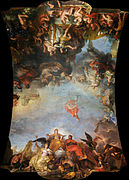
The King rules by Himself, 1661 (top) and The pomp of France's neighboring powers (bottom)
-

Takeover of the city and citadel of Gand in six days, 1678 and Spanish deportment countered by the takeover of Ghent
-

Order restored to the Kingdom'south finances, 1662
-

The peace ended in Aix-la-Chapelle, 1668
-

Acquisition of Dunkirk, 1662
-

Symbol of Louis Xiv
Functions [edit]
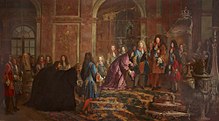
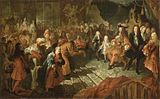
Louis 14 receiving the Doge of Genoa at Versailles on 15 May 1685

The signing of peace to finish World War 1 in the Hall of Mirrors, 28th June 1919
During the 17th century, the Hall's main purpose was to serve as a kind of covered promenade for Louis Xiv's visit to the chapel. He entered the gallery at least in one case a solar day and from 1701, the rex'due south bedroom lay behind the middle wall of the gallery. Courtiers assembled to run into the male monarch and members of the purple family and might make a particular request past intoning: "Sire, Marly?". This was the manner in which nobles were able to obtain a much sought-afterward invitation to 1 of the king's business firm parties at Marly-le-Roi, a villa Louis Xiv had built northward of Versailles on the route to Saint-Germain-en-Laye.
Its central location and size predestined the Hall of Mirrors every bit a place for court festivities such every bit the wedding of the Duke of Burgundy (the Petit Dauphin) with Marie Adélaïde of Savoy, the wedding of Louis, Dauphin of France and Maria Teresa of Espana in 1645 and the wedding of Louis XVI and Marie Antoinette in 1770. In the successive reigns of Louis XV and Louis XVI, the Hall of Mirrors continued to serve for family and court functions. Embassies, births, and marriages were held in this room. The nigh celebrated event of the 18th century on 25 February 1745 was the celebrated Yew Tree Ball. Information technology was during this costume brawl that Louis XV, who was dressed as a yew tree, met Jeanne-Antoinette Poisson d'Étiolles, who was costumed equally Diana, goddess of the hunt. Jeanne-Antoinette, who became Louis XV'southward mistress, is better known to history as the Marquise de Pompadour.
Foreign audiences were granted, including that of the Doge of Genoa in 1685 and the embassy of Sultan Mahmud I of the Ottoman Empire in 1742. Of all the events that transpired in this room during the reign of Louis XIV, the Siamese Embassy of 1685-1686 has been cited as the most opulent. At this fourth dimension, the Hall of Mirrors and the grand appartements were still decorated with the original argent furniture. In its heyday, over iii,000 candles were used to light the Hall of Mirrors. In February 1715, Louis Xiv held his last embassy in the Hall when he received Mohammad Reza Beg, ambassador of the Shah of Persia, Sultan Husayn.[17] [18]
On 18 Jan 1871 during the siege of Paris at the conclusion of the Franco-Prussian War, the Prussian male monarch, William I, was, led by Otto von Bismarck, alleged German emperor — thus establishing the German Empire — in the Hall of Mirrors by the assembled German princes and lords. The choice fell amid other things like Versailles being the headquarters of the united German armies, on the Hall of Mirrors because its ceiling paintings glorified the conquest of German language territories past France. The French nation regarded this ceremony every bit deeply humiliating. The event greatly contributed to the farther accretion of the Franco-German enmity.[19] A few decades later French Prime Minister Clemenceau consciously chose the Hall of Mirrors equally the site to sign the Treaty of Versailles on 28 June 1919, that officially ended Earth War I, to dismantle the High german Empire in the room where information technology had been proclaimed.[xx] [21] [22]
The Hall of Mirrors remains reserved for official ceremonies of the French Commonwealth. Notable events during the 20th century were the reception of US-President John Fitzgerald Kennedy and his wife past Charles De Gaulle, the reception of the Shah of Islamic republic of iran Mohammad Reza Pahlavi by Valéry Giscard d'Estaing in 1974 or the invitation of representatives of the Group of Seven top past President François Mitterrand from June 4 to 6, 1982.
Gallery [edit]
Historical depictions of the Hall of Mirrors
-

Le roi gouverne par lui-même, the modello for the central panel of the ceiling of the Hall of Mirrors ca. 1680 by Charles Le Brun, (1619–1690).
-

Mirror panels in the Hall of Mirrors
-

-
-
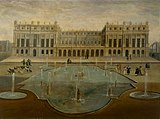
The eastern facade of the palace earlier the construction of the Hall of Mirrors, 1675
-

Ceiling of the Hall of Mirrors.
References [edit]
- ^ David Sinclair (31 July 2011). Hall Of Mirrors. Random House. pp. ane–. ISBN978-ane-4464-7356-half-dozen.
- ^ Nicholas Boyle (28 February 2008). High german Literature: A Very Short Introduction. OUP Oxford. pp. xvi–. ISBN978-0-19-157863-2.
- ^ "Palace of Versailles | palace, Versailles, France". Encyclopedia Britannica . Retrieved iii May 2020.
- ^ Joanna Banham (1997). Encyclopedia of Interior Design. Routledge. pp. 730–. ISBN978-ane-136-78758-4.
- ^ "La galerie des Glaces". Versailles Tourisme. Retrieved one May 2020.
- ^ "Palace of Versailles – The Hall of Mirrors". Chateau Versailles. Retrieved i May 2020.
- ^ Kimball, Fiske (1940). "Mansart and le Brun in the Genesis of the Grande Galerie de Versailles". The Art Bulletin. Informa United kingdom Express. 22: 1–six. doi:ten.1080/00043079.1940.11409005.
- ^ "La galerie des Glaces" (PDF). Chateau Versailles. Retrieved 4 May 2020.
- ^ Riccardo Biancchini (xi February 2019). "Palace of Versailles". In Showroom. Retrieved 4 May 2020.
- ^ "Hall of Mirrors". David Grubin Productions. 12 September 2006. Retrieved 4 May 2020.
- ^ Felipe Chaimovich (25 September 2009). "Mirrors of Order: Versailles and the Utilize of Flat Reflected Images". Visual Resources. Informa UK Limited. 24 (iv): 353–367. doi:10.1080/01973760802442756. S2CID 194077148.
- ^ B. Velde (21 Jan 2013). Seventeenth–Century Varec Glass from the Slap-up Hall of Mirrors at Versailles. John Wiley & Sons. pp. 563–572. doi:10.1002/9781118314234.ch26. ISBN9781118314234.
- ^ "Restoration of the Hall of Mirrors gets under way" (PDF). Vinci. 1 July 2004. Retrieved 13 May 2020.
- ^ "The "Grand Versailles" project". Chateau Versailles. Retrieved thirteen May 2020.
- ^ Marcia B. Hall (2019). The Power of Colour: V Centuries of European Painting. Yale University Press. pp. 148–. ISBN978-0-300-23719-1.
- ^ Gillian Perry; Colin Cunningham (1999). Academies, Museums, and Canons of Art. Yale University Press. pp. 86–. ISBN978-0-300-07743-8.
- ^ "The Hall of Mirrors at The Palace of Versailles". Study com. Retrieved i May 2020.
- ^ Ronald S. Love (27 April 2016). "Rituals of Majesty: France, Siam, and Courtroom Spectacle in Royal Image-Building at Versailles in 1685 and 1686". Canadian Journal of History. Academy of Toronto Press. 31 (2): 171–198. doi:10.3138/cjh.31.two.171.
- ^ "Proclamation of the German Empire, 1871". Palace of Versailles. 22 Nov 2016. Retrieved 7 Apr 2020.
- ^ "1919 - XXth century - Over the centuries - Versailles 3d". www.versailles3d.com . Retrieved 7 April 2020.
- ^ Michael Stürmer (1 July 2007). "Versailles, ein Schicksalsort Europas". HISTORY com. Retrieved three May 2020.
- ^ Daniëlle Kisluk-Grosheide; Bertrand Rondot (sixteen April 2018). Visitors to Versailles: From Louis XIV to the French Revolution. Metropolitan Museum of Art. pp. 1–. ISBN978-i-58839-622-8.
Further reading [edit]
Books [edit]
| Journals [edit]
|
External links [edit]
- Fullscreen interactive panoramic image of Hall of Mirrors
 Media related to Hall of Mirrors (Palace of Versailles) at Wikimedia Eatables Coordinates: 48°48′17.4″N 2°vii′thirteen.ii″E / 48.804833°Due north 2.120333°E / 48.804833; 2.120333
Source: https://en.wikipedia.org/wiki/Hall_of_Mirrors

Post a Comment for "Photos French Louis Xiv Mirror With Hand Painting Art 18001900s"