Rise of the Runelords What to Do After
Overview
Yous are an adventurer. Along with your fellow political party members you lot will travel to locations, find treasures, allies and monsters! Apply your abilities and items wisely and coordinate your efforts with your young man political party members to defeat the Villain earlier time runs out.
Agree it! This sounds like a function-playing game, right? Not quite an RPG, not quite a deck-builder, definitely cooperative (most of the fourth dimension), the Pathfinder Chance Carte Game allows players to feel an archetypal fantasy run a risk in a refreshing new fashion.
Ready Up
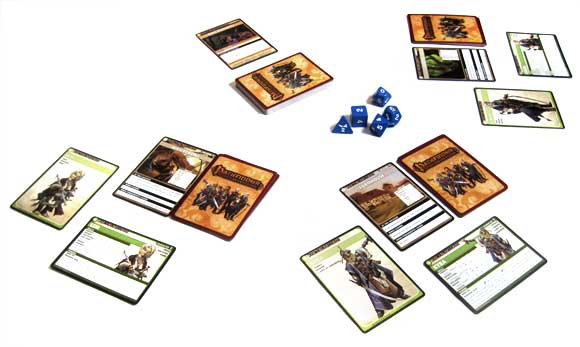
Annotation: Set upwardly for the game varies depending upon whether you lot are playing a Scenario, an Risk or a total Chance Path. In addition, all of the cards will need to exist sorted and placed in their respective compartments in the box. The fix beneath assumes this is the players' start time playing. After initial plays, set upward volition vary based on where the players are in their adventure path.
Who do y'all retrieve yous are?
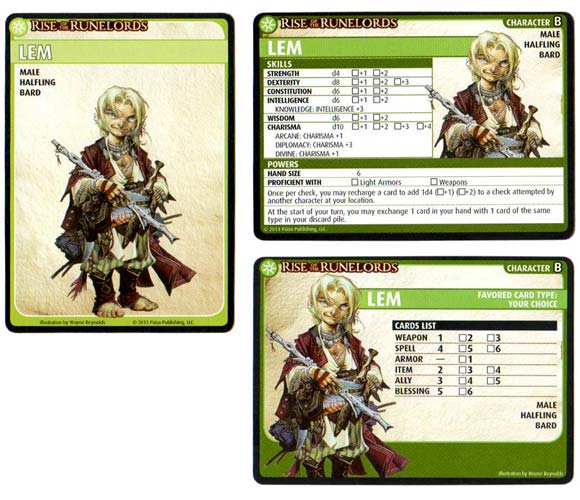
The get-go step is to choose the characters you and your beau adventurers will be playing. Take the Character carte du jour and its Token card and place them in front of you. So have a wait at the card types and number that will make up that character's starting deck. (There are deck suggestions for new players), and build your character'due south deck using this listing. Shuffle your deck and place it nearby.
What lies ahead?
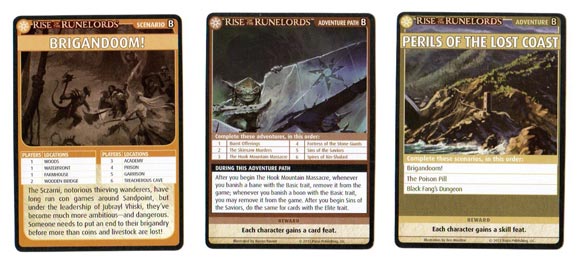
Choose a Scenario card and place it confront on the table. The Scenario card lists the type and number of locations (based on the number of players) that volition make upwards the take chances. It also gives the players their goal to reach victory! (Usually by facing a nasty villain!) Take the Locations listed and place them in the middle of the table with some infinite between.
What lies within?
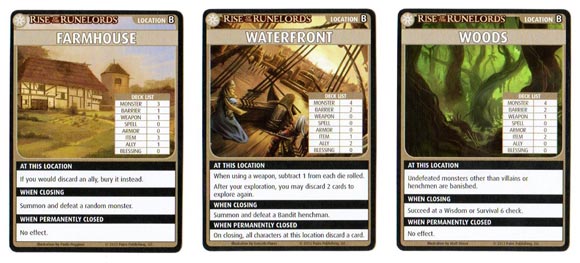
Location cards list the bill of fare types that volition make up the cards encountered at that location. Randomly deal the number of cards listed into a face down stack and fix it aside for a moment. Cheque back on the Scenario bill of fare and find the Villain and Henchmen listed at that place, go catch them from the box and deal a number of henchmen equal to the number of locations you have. Place i of each henchman (including the large bad villain) onto each Location deck then shuffle each. You have simply created the encounters for each location!
Set the timer!
Randomly deal out xxx cards from the Blessing deck and identify them face down. This forms the timing mechanism for the adventure.
Now, each player places their character Token card at any location. More than one character can start at the same location if you wish. Players and so cheque their Character card and describe cards to form their starting paw equal to their paw size. Check that character'due south Favored Card Blazon. If you didn't get at to the lowest degree one of that type bill of fare, re-shuffle and redraw until y'all do.
Determine who goes offset, take hold of the die and set for adventure!
Gameplay
Each player's turn consists of five steps that are performed in guild. Once completed, play passes to the next character clockwise.
1. Advance the Blessings Deck – Draw the meridian carte du jour from the Blessings Deck and place it face up in a discard pile. If at any fourth dimension you must flip 1 of the Blessing cards and you cannot, the game ends and the players accept lost the scenario.
2. Give a Card – Yous may give one menu from your hand to another character at your location.
three. Move – You lot may movement your grapheme token from its current location to any other location.
iv. Explore – Flip the summit card of your current location deck. You are about to accept an Encounter! It will either be a "Boon" or a "Bane."
-
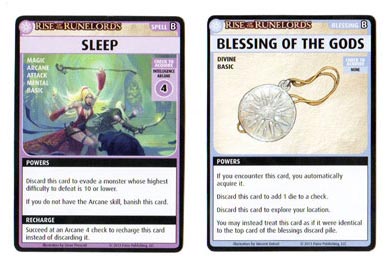
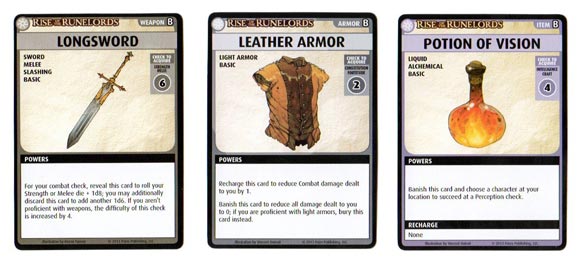
- A Boon is something cool: a Weapon, Spell, Armor, Ally, Detail or a Blessing. When revealed, the character may attempt to acquire it by "attempting a check." (Encounter beneath) If unsuccessful, the card will be "Banished" or returned to the game box for the rest of the scenario. If the check is successful, the card is immediately added to the role player's hand of cards.
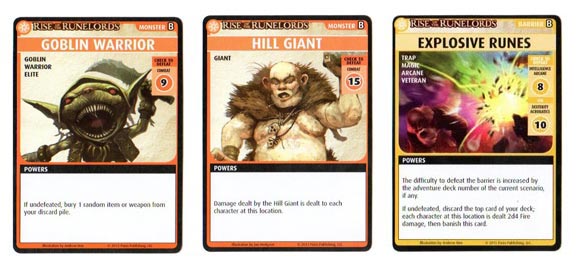
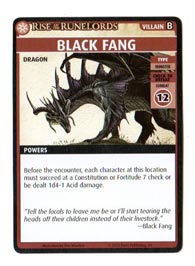
- A Blight is something non cool: Villains, Henchmen, Monsters and Barriers. These will accept to be overcome, and of course in the instance of the Villain and his Henchmen, are the main focus for success in the adventure. Defeating a Blight banishes that card. However, failing to defeat a Blight results in dire consequences – normally taking damage. Damage is taken past discarding cards from a histrion'southward hand.
5. Reset your Hand – A player may discard whatsoever number of cards, or must discard them if they exceed their character's hand size. Then the histrion draws up to their starting manus size.
If at any time a player must draw from their draw deck and are unable to draw up to their hand size, their character has died. That player may no longer play in the scenario.
Attempting a Check
Whatever time a graphic symbol encounters a bill of fare from a Location deck, they must "Effort a Check" to defeat the baddies or grab the goodies. This is the foundation of success and failure in advancing through the stages of the adventure. Here is how it works:
-
- Make up one's mind the Difficulty of the bank check: Look at the skill and number listed in the circle in the upper-right of the card encountered. This is the Difficulty of the check. You volition take to roll equal to or higher than this number to be successful.
- Determine which dice to utilize: Attempting a check will usually require you to apply a skill. Bank check your character carte du jour and take the die that is associated with that skill. (look closely – you may receive a bonus to that skill!)

-
- Play cards: All players may have a take a chance to play no more than than one carte du jour of whatsoever type to affect the curlicue. This may add some other skill dice, or add another die of a unlike type. Take these dice in hand as well.
- Use Powers: Your character may have Powers that tin affect a cheque. Just read what consequence the Ability has and utilise it.
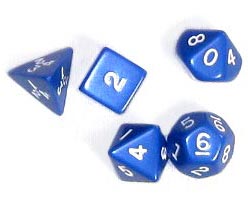
- Whorl em! Roll all of the dice you take assembled to make the check. If your roll is equal to or higher than the difficulty, you succeed. If it is lower you neglect the check.
Winning!
Each Scenario has a specific goal that players are trying to attain. Ordinarily this involves confronting a major Villain and his henchmen and defeating them. During gameplay, Locations tin can be "airtight" so that the Villain has nowhere to run. All players will win the game if they fulfill the goal of the scenario or take chances within the allotted time. That is, before the Blessing deck runs out. If not, the game results in a loss for everyone. But that's not all…
Your Characters go on and on…
After a scenario, if completed successfully, the group will earn the reward listed on the scenario carte. This could exist a Loot carte du jour, or additional Feats. In between games, any cards that a role player caused tin can be added to their deck. However, that graphic symbol cannot accept more cards of a certain type than are listed on their character menu. In this fashion, cards tin be traded with other players, so that their characters can utilize them if they demand them. (Say for case Valeros found a Spell. Useless? Ah, but non to your best friend Seoni!) Characters' decks are then rebuilt and the next stage of the hazard tin begin. Just like any great RPG, characters can eventually receive upgrades to their skills, learn new bonuses, even achieve new classes that expand their level and powers! Thus, the adventure will go along and on…
Components
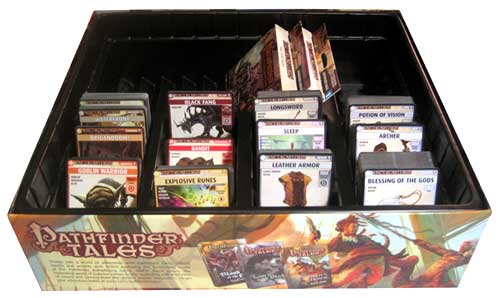
The principal component of the game is of course cards. Compared to many other card games out there the carte du jour template is non striking and the artwork is very familiar to those who play Pathfinder RPG. All that said, the cards are extremely functional in providing a catalyst to amazing story telling. The art is very adept, the flavor text is excellent and the card stock is resilient. The HUGE box (see below) is huge for a reason. Also storing the xviii dissimilar card types at that place is space to store players' Grapheme decks betwixt adventures and special slots for upcoming Run a risk decks.
Learning Curve
Moderate. If yous are a gamer that has never played an RPG, skill checks and the thought of an run a risk campaign setting may non come piece of cake. Especially when manipulating the cards during gameplay (See Final Thoughts). For those who have played RPGs, the mechanics volition be second nature. Withal, the adventures will yet evidence to be a difficult test of cooperation and manus management.
Who would savor this game?
Family Gamer {aye}
This game can provide an amazing story driven risk to a family unit game nighttime with older children. Being cooperative (like most RPGs) older players can help the younger. Note that the game does require a lot of reading.
Strategy Gamer {yes}
Each take chances path and scenario has random elements to exist sure, but each is crafted to include specific cards of a sure type. It is up to the players to utilize a strategy based on their characters' strengths to attain victory. This is a great, although not pure, strategy game.
Coincidental Gamer {yeah}
Catch a character card, assemble a deck, proceed an run a risk and put it away. Whether yous swoop in deep and play forever or just every at present and then, this is a neat game for Casual gamers.
Gorging Gamer {yes}
This game is an amazing combination of tactical and strategic bill of fare play, function-playing elements, dice-building and upgradeable character cards that tin be saved between adventures. It ticks every single Avid gamer'southward box.
Ability Gamer {maybe}
This is not necessarily a game category that would attract a Ability gamer. However, the fact that characters are upgradeable and the game provides a difficult and deep cooperative experience that will last through many campaigns makes this tempting…
Final Thoughts
Every now and then a game comes along that makes you lot slap your caput and wish you lot had thought of it. What Mike Selinker has washed seems so very obvious: take a role-playing game and dribble it downward into a card game. Use the foundational mechanics of those RPGs (such every bit making skill checks), make full a tabletop with locations and set the players loose. Aha! Only what well-nigh character skill advancement, weapon proficiency, unique form traits and powers, enemies, treasures, traps, and most chiefly the carrying over of your character from i quest to the side by side – gaining levels and advancing in power over a long catamenia of time? This seems like a task incommunicable to orchestrate with decks of cards. Like a master composer, Selinker has succeeded. Here are some standout features:
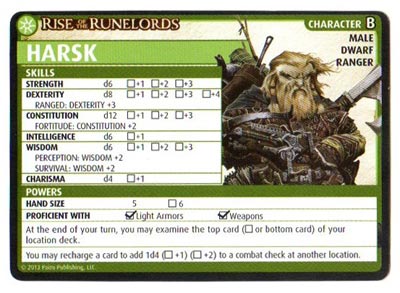
Everything is on the cards. The ii-sided Graphic symbol cards listing all the die types needed for the skill checks, all character class restrictions (your character'due south deck list), powers and so along. The items, weapons and armor provide various levels of effectiveness based on how yous use them. (see below) The Scenario cards listing the locations, Villains and henchmen and rewards for success. The Monsters list special abilities and effects and of course the difficulty in defeating them. So after fix up, the game matrix kicks in and allows reasonably free movement and options to explore the mural of the adventure.
Information technology's an ballsy adventure with a plot. There are very few plot or scenario based card games out there. The recent popular trend in "story telling" games either is minimalistic like In one case Upon a Fourth dimension or may require many more components and features such equally the excellent game Mice and Mystics. Here you lot have a not-deck building, non-collectible, non… board game… card game feel that weaves a very specific tale: recreating the Rise of the Runelords story line from the Pathfinder RPG series. The game challenges you to be a office of the tale and create your own chapters and experiences within it.
The card play is groundbreaking. Some of the best game designs include multi-utilize cards. Here, that mechanic is taken to a new height and is the most innovative aspect of the game. Each actor's deck is their health. This is non new by any ways, all the same the starting deck size for all the basic characters is 15. This minimal amount of cards is ingeniously balanced with the multiple uses for those cards. They are: Reveal, Display, Discard, Recharge, Bury and Banish. "Revealing" a card just means evidence information technology, use its event and it goes back in your hand. Recharging a card allows you to use its effect and place information technology on the bottom of your draw pile. (adding to your Wellness.) In these two instances the card may be used again. For a greater card consequence y'all can Display, Discard, Bury or Banish a carte. You lose it (and information technology counts against your health) but the gameplay event is much more than devastating. With these different forms of menu activations come up the kinds of tough gameplay choices that make the game a challenge.
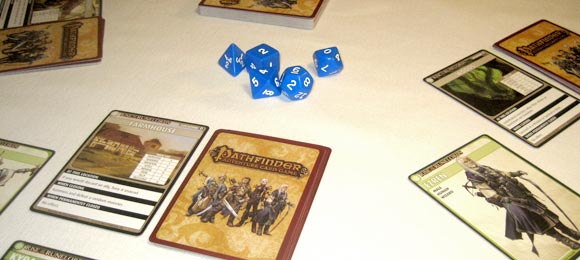
This is a game that typifies our hobby. It is the very all-time of what a game can offer: a solid fantasy theme experience, with excellent strategic options, corking replay value (even with the base set alone), easy to learn mechanics with diverse gameplay effects, cooperative determination making, some fun dice rolling, rewards and leveling, treasures, monsters, gainsay and exploration. Whew! Virtually of all, you have an amazing immersive feel. The game is particularly immersive because you lot carry the game with you lot between sessions. By saving your character deck, y'all prepare for the next stage or game feel, ramping up the anticipation for the next game! If y'all are like most hobby gamers, this means that you'll retrieve and talk about the game even when you are not playing. That's the mark of an excellent game. Just have a await at the last page of the rules and see the extraordinary number of people that had their hands in the creation of the game. Conspicuously this is a game that has had many talented people's hopes and passions infused into it.
Near of all, yous never feel like you are playing a gear up of mechanics. The game is triumphantly elegant. There is a treasure trove of replay value in this box. Yeah, information technology will crave and investment if you chose to dive in head first: new Take chances decks will be released every month. But that'southward what this hobby is nigh… right? Our advice, driblet most of those other silly deck builders and begin a menu game journey that volition exit you recounting tales of your adventures for years to come. What more can any gamer ask?
Source: https://boardgaming.com/games/card-games/pathfinder-adventure-card-game-rise-of-the-runelords-base-set

Post a Comment for "Rise of the Runelords What to Do After"