what two rivers flow together to make the chemung river in ny state
| New York | |
|---|---|
| State | |
| State of New York | |
| Flag Seal | |
| Nickname(s): The Empire State | |
| Motto(due south): Excelsior (in Latin) [ane] | |
| Anthem: "I Honey New York" | |
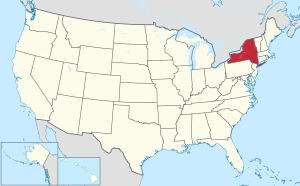 Map of the United States with New York highlighted | |
| State | United States |
| Earlier statehood | Province of New York |
| Admitted to the Spousal relationship | July 26, 1788 (11th) |
| Capital | Albany |
| Largest city | New York Urban center |
| Largest metro and urban areas | Greater New York |
| • Upper business firm | {{{Upperhouse}}} |
| • Lower house | {{{Lowerhouse}}} |
| U.South. senators | {{{Senators}}} |
| Area | |
| • Full | 54,555[two] sq mi (141,297 km2) |
| • State | 47,126 sq mi (122,057 kmii) |
| • Water | 7,429 sq mi (xix,240 km2) 13.6% |
| • Rank | 27th |
| Dimensions | |
| • Length | 330 mi (530 km) |
| • Width | 285 mi (455 km) |
| Elevation | 1,000 ft (300 m) |
| Highest height (Mount Marcy[three] [4] [v]) | 5,344 ft (1,629 grand) |
| Everyman summit (Atlantic Sea[4] [five]) | 0 ft (0 chiliad) |
| Population | |
| • Total | {{{two,000Pop}}} |
| Language | |
| Fourth dimension zone | UTC−05:00 (Eastern) |
| • Summer (DST) | UTC−04:00 (EDT) |
| USPS abridgement | NY |
| ISO 3166 code | United states of america-NY |
| Traditional abbreviation | N.Y. |
| Breadth | forty° 30′ Due north to 45° 1′ N |
| Longitude | 71° 51′ W to 79° 46′ Westward |
| Website | www |

| New York state symbols | |
|---|---|
 Flag of New York | |
 | |
| Living insignia | |
| Bird | Eastern bluebird |
| Fish | Brook trout (fresh water), Striped bass (salt h2o) |
| Flower | Rose |
| Insect | Nine-spotted ladybug |
| Mammal | North American beaver |
| Reptile | Mutual snapping turtle |
| Tree | Saccharide maple |
| Inanimate insignia | |
| Drink | Milk |
| Food |
|
| Fossil | Eurypterus remipes |
| Gemstone | Garnet |
| Shell | Bay scallop |
| Slogan | I Love New York |
| Other | Bush: Lilac bush Sport: Baseball |
| Country route mark | |
 | |
| State quarter | |
 Released in 2001 | |
| Lists of United States state symbols | |
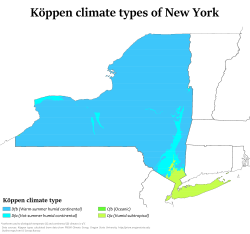

Physical and political features of New York
The geography of New York state varies widely. Most of New York is dominated by farms, forests, rivers, mountains, and lakes. New York'due south Adirondack Park is larger than any U.S. National Park in the face-to-face Us.[6] Niagara Falls, on the Niagara River as information technology flows from Lake Erie to Lake Ontario, is a pop attraction. The Hudson River begins near Lake Tear of the Clouds and flows southward through the eastern part of the state without draining lakes George or Champlain. Lake George empties at its north end into Lake Champlain, whose northern end extends into Canada, where information technology drains into the Richelieu River and then the St. Lawrence. Four of New York City's five boroughs are on the three islands at the mouth of the Hudson River: Manhattan Island, Staten Isle, and Brooklyn and Queens on Long Isle.
"Upstate" is a common term for New York counties north of suburban Westchester, Rockland and Dutchess counties. Upstate New York typically includes the Catskill Mountains or areas North of the Catskill Mountains, the Majuscule district, The Adirondacks, the Erie Canal, Lake Champlain, Otsego Lake, Oneida Lake; rivers such as the Delaware, Genesee, Mohawk, and Susquehanna. The highest elevation in New York is Mount Marcy of the Adirondack Mountains. New York is the 27th largest state .
Location and size [edit]

Location of New York in the United States
New York is located in the northeastern United states, in the Mid-Atlantic Census Bureau division. New York covers an area of 54,556 square miles (141,299 km2) making it the 27th largest state by total area (but 30th by land area).[vii] The country borders six U.S. states: Pennsylvania and New Jersey to the south, and Connecticut, Rhode Isle (across Long Island Sound), Massachusetts, and Vermont to the east. New York likewise borders the Canadian provinces of Ontario and Quebec to the north. Additionally, New York touches the Atlantic Ocean to the southeast, and ii of the Slap-up Lakes: Lake Erie to the west and Lake Ontario to the northwest.
Geology [edit]
![[icon]](https://upload.wikimedia.org/wikipedia/commons/thumb/1/1c/Wiki_letter_w_cropped.svg/20px-Wiki_letter_w_cropped.svg.png) | This section needs expansion. You can assist by adding to it. (April 2017) |
- Main article: Geology of New York (country)
New York is part of the Marcellus Shale, a gas-rich rock formation which also extends across Ohio, Pennsylvania and Westward Virginia.[8]
Topography [edit]
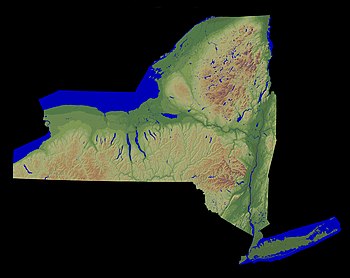
New York lies upon the portion of the Appalachian Mountains where the mountains generally assume the character of hills and finally sink to a level of the lowlands that surround the great depression filled by Lake Ontario and the St. Lawrence River. Three distinct mount masses can be identified in the state. The nearly easterly of these ranges—a continuation of the Blueish Ridge Mountains of Virginia—enters the state from New Jersey and extends northeast through Rockland and Orange counties to the Hudson River, continuing on the east side of that river equally the highlands of Putnam and Dutchess counties. A northerly extension of the same range passes into the Green Mountains of western Massachusetts and Vermont. This range is known in New York as the Hudson Highlands. The highest peaks are i,000 to 1,700 feet (300 to 520 m) to a higher place sea level. The rocks that compose these mountains are principally archaic or igneous, and the mountains themselves are rough, rocky, precipitous, and unfit for cultivation.[9]
The second series of mountains enters the state from Pennsylvania and extends northeast through Sullivan, Ulster, and Greene counties, terminating and culminating in the Catskill Mountains west of the Hudson. The highest peaks are iii,000 to iv,200 feet (910 to 1,280 m) above sea level. The Shawangunk Mountains, a high and continuous ridge extending between Sullivan and Orangish counties and into the southern function of Ulster County, is the extreme eastern range of this series. The Helderberg and Hellibark Mountains are spurs extending due north from the chief range into Albany and Schoharie counties. This whole mountain system is principally equanimous of rocks of the New York organisation higher up the Medina sandstone. The summits are by and large crowned with reddish sandstone and with the conglomerate of the coal measures. The declivities are steep and rocky, and a large share of the surface is besides rough for cultivation.[9]

The third mountainous region, occupying the northeast part of the country, is known equally the Adirondack Mountains. The region is bounded to the south by the Mohawk River, south of which the highlands go part of the Allegheny Plateau, in the class of broad, irregular hills, broken by the deep ravines of streams. The valley of the Mohawk separates the Allegheny Plateau to the south from the highlands leading to the Adirondacks to the north, reaching its narrowest point in the neighborhood of Fiddling Falls, the Noses, and other places. North of the Mohawk the highlands extend northeast in several distinct ranges, all terminating upon Lake Champlain. The culminating point of the whole system, and the highest mountain in the state, is Mount Marcy, continuing 5,344 feet (1,629 m) above bounding main level. The rocks of all this region are principally of igneous origin, and the mountains are usually wild, rugged, and rocky. A big share of the surface is entirely unfit for tillage, merely the region is rich in minerals, and especially in an excellent variety of fe ore.

Landscape regions of New York
In western New York, a serial of hills forming spurs of the Allegheny Mountains enter the country from Pennsylvania and occupy the entire southern one-half of the west part of the state. An irregular line extending through the southerly counties forms the watershed that separates the northern and southern drainage; and from information technology the surface gradually declines northward until it finally terminates in the level of Lake Ontario. The portion of the state lying due south of this watershed and occupying the greater part of the 2 southerly tiers of counties is entirely occupied by these hills. Along the Pennsylvania line they are usually sharp and are separated by narrow ravines, just toward the northward their summits become broader and less broken. A considerable portion of the highland region is too steep for profitable cultivation and is best adapted to grazing. The highest summits in Allegany and Cattaraugus counties are 2,000 to 2,500 feet (610 to 760 m) above body of water level.[nine]
From the summits of the watershed, the highlands usually descend toward Lake Ontario in a series of terraces, the edges of which are outcrops of different rocks beneath the surface. These terraces are usually smooth, and, although inclined toward the north, the inclination is generally so slight that they appear level. Between the hills of the south and the level state of the n is a cute rolling region, the ridges gradually declining toward the n. In that role of the state, south of the most eastern mount range, the surface is more often than not level or broken by low hills. In Manhattan and Westchester County, these hills are principally equanimous of primitive rocks. The surface of Long Island is generally level or gently undulating. A ridge 150 to 200 feet (46 to 61 m) high, composed of sand, gravel, and dirt, extends east and west beyond the island n of its center.[ix]
Rivers and lakes [edit]

The river system of the land has two general divisions. The offset is the streams tributary to the Corking Lakes[10] and the St. Lawrence River. The 2nd are those tributaries that menstruation in a general southerly management. The watershed split that separates these 2 systems extends in an irregular line due east from Lake Erie, through the southern tier of counties to near the northeast corner of Chemung County. It then turns northeast to the Adirondack Mountains in Essex Canton, and then southeast to the east extremity of Lake George, and so nearly e to the due east border of the state.[9]
The northerly partition has five full general subdivisions. The most westerly of these comprises all the streams flowing into Lake Erie and the Niagara River and those flowing into Lake Ontario west of the Genesee River. In Chautauqua Canton, the streams are short and rapid, equally the watershed approaches within a few miles of Lake Erie. Cattaraugus, Buffalo, Tonawanda, and Oak Orchard creeks are the most important streams in this division. Buffalo Creek is chiefly noted for forming Buffalo Harbor at its mouth; and the Tonawanda for 12 miles (19 km) from its mouth was once used for canal navigation. Oak Orchard and other creeks flowing into Lake Ontario descend from the interior in a series of rapids, affording a large corporeality of waterpower.[ix]

The 2d subdivision comprises the Genesee River and its tributaries. The Genesee rises in the northern function of Pennsylvania and flows in a generally northerly management to Lake Ontario. Its upper course is through a narrow valley bordered by steep, rocky hills. Upon the line of Wyoming and Livingston counties, it breaks through a mountain barrier in a deep gorge and forms the Portage Falls. Below this betoken the grade of the river is through a valley 1 to ii miles (1.6 to 3.ii km) broad and bordered past banks 50 to 150 anxiety (15 to 46 chiliad) loftier. At Rochester it flows over the precipitous edges of the Niagara limestone, forming the Upper Genesee Falls; and iii miles (4.8 km) beneath it flows over the edge of the Medina sandstone, forming the Lower Genesee Falls. The primary tributaries of this stream are Canaseraga, Honeoye, and Conesus creeks from the south, and Oatka and Black creeks from the w. Honeoye, Canadice, Hemlock, and Conesus lakes—four of the Finger Lakes—lie within the Genesee Basin.[9] The third subdivision includes the Oswego River and its tributaries, and the small streams flowing into Lake Ontario between the Genesee and Oswego rivers. The basin of the Oswego includes about of the inland lakes, which grade a peculiar feature of the landscape in the interior of the state. The principal of these lakes are Cayuga, Seneca, Canandaigua, Skaneateles, Crooked, and Owasco lakes, all occupying long, narrow valleys, and extending from the level country in the eye far into the highland region of the south (many of those lakes just mentioned are also role of the Finger Lakes). The valleys they occupy announced like immense ravines formed by some tremendous force that tore the solid rocks from their original beds, from the full general level of the surrounding summits, down to the present bottoms of the lakes. Oneida and Onondaga lakes occupy level state in the northeast part of the Oswego Basin. Mud Creek, the near westerly branch of the Oswego River, takes its rise in Ontario County, flows northeast into Wayne County, where information technology unites with Canandaigua Outlet and takes the name of Clyde River; then it flows eastward to the west line of Cayuga County, where it empties into the Seneca River. This latter stream, made upwardly of the outlets of Seneca and Cayuga Lakes, from this point flows in a northeasterly course, and receives successively the outlets of Owasco, Skaneateles, Onondaga, and Oneida lakes. From the mouth of the final-named stream it takes the proper name Oswego River, and its course is nearly due north to Lake Ontario.[9]
The fourth subdivision includes the streams flowing into Lake Ontario and the St. Lawrence River east of the mouth of the Oswego. The principal of these are the Salmon, Black, Oswegatchie, Grasse, and Raquette rivers. The water is commonly very dark, being colored with iron and the vegetation of swamps.[9]
The fifth subdivision includes all the streams flowing into Lakes George and Champlain. They are generally mountain torrents, oftentimes interrupted by cascades. The principal streams are the Chazy, Saranac, and Ausable rivers, and Wood Creek. Deep strata of Tertiary clay extend forth the shores of Lake Champlain and Wood Creek. The water of most of the streams in this region is colored past the atomic number 26 over which information technology flows.

The 2d full general division of the river arrangement of the state includes the basins of the Allegheny, Susquehanna, Delaware, and Hudson. The Allegheny Basin embraces the southerly one-half of Chautauqua and Cattaraugus counties and the southwest corner of Allegany County. The Allegheny River enters the state from the due south in the southeast corner of Cattaraugus County, flows in almost a semicircle, with its outward curve toward the due north, and flows out of the state in the southwest part of the aforementioned canton. It receives several tributaries from the north and east. These streams by and large flow in deep ravines bordered past steep, rocky hillsides. The watershed between this basin and Lake Erie approaches inside a few miles of the lake, and is elevated 800 to 1,000 anxiety (240 to 300 1000) to a higher place it.[9]

The Susquehanna Basin occupies almost i-third of the south border of the land. The river takes its rise in Otsego Lake, and, flowing southwest to the Pennsylvania line, receives Charlotte River from the due south and the Unadilla River from the n. Subsequently a course of a few miles in Pennsylvania, it again enters New York and flows in a general westerly direction to near the western border of Tioga County, whence it turns south and again enters Pennsylvania. Its principal tributary from the north is the Chenango River. The Tioga River enters New York from Pennsylvania near the eastern edge of Steuben County, flows n, receives the Canisteo River from the westward and the Cohocton River from the northward. From the oral cavity of the latter, the stream takes the proper noun Chemung River, and flows in a southeast management, into the Susquehanna River in Pennsylvania, a few miles south of the state line. The upper course of these streams is generally through deep ravines bordered past steep hillsides, but below they are bordered by wide intervales.[9]

The Delaware Basin occupies Delaware and Sullivan counties and portions of several of the side by side counties. The north or chief branch of the river rises in the northeast part of Delaware County and flows southwest to almost the Pennsylvania line; and so information technology turns southwest and forms the boundary of the state to the line of New Jersey. Its principal branches are the Pepacton and Neversink rivers. These streams all flow in deep, narrow ravines bordered by steep, rocky hills.[ix]
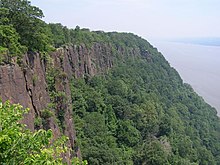
The bowl of the Hudson occupies about two-thirds of the east edge of the land, and a large territory extending into the interior. The remote sources of the Hudson are amid the highest peaks of the Adirondacks, more than 4,000 feet (1,200 g) in a higher place sea level. Several of the little lakes that form reservoirs of the Upper Hudson are two,500 to three,000 anxiety (760 to 910 m) in a higher place body of water level. The stream rapidly descends through the narrow defiles into Warren Canton, where it receives from the east the outlet of Schroon Lake, and the Sacandaga River from the west. Below the mouth of the latter the river turns eastward, and breaks through the barrier of the Luzerne Mountains in a series of rapids and falls. At Fort Edward information technology again turns south and flows with a rapid current, frequently interrupted by falls, to Troy, 160 miles (260 km) from the ocean. At this identify the river falls into an estuary, where its electric current is afflicted past the tide; and from this place to its rima oris information technology is a broad, deep, sluggish stream. About lx miles (97 km) from its mouth the Hudson breaks through the rocky barrier of the highlands, forming the most easterly of the Appalachian Mountain ranges; and forth its lower course it is bordered on the west by a well-nigh perpendicular wall of basaltic stone 300 to 500 anxiety (91 to 152 1000) loftier, known as The Palisades. Higher up Troy, the Hudson receives the Hoosic River from the east and the Mohawk River from the west. The former stream rises in western Massachusetts and Vermont, and the latter near the center of New York.[9]
At Little Falls and The Noses, the Mohawk breaks through mountain barriers in a deep, rocky ravine; and at Cohoes, nigh 1 mile (one.six km) from its oral cavity, information technology flows downwards a perpendicular precipice of 70 feet (21 m). Beneath Troy the tributaries of the Hudson are all comparatively small streams. South of the highlands the river spreads out into a broad expanse known every bit Haverstraw Bay. A few pocket-sized streams upon the farthermost eastern border of the country flow eastward into the Housatonic River, and several small branches of the Passaic River ascension in the southern part of Rockland County.[9]
Lake Erie forms a portion of the western boundary of the state. It is 240 miles (390 km) long, with an average width of 38 miles (61 km), and it lies generally west of the bounds of the country. It is 334 anxiety (102 thousand) in a higher place Lake Ontario, 565 feet (172 grand) to a higher place bounding main level, and has an average depth of 120 feet (37 m). The greatest depth ever obtained by soundings is 270 feet (82 one thousand). The harbors upon the lake are Buffalo, Silverish Creek, Dunkirk, and Barcelona.[9]


The Niagara River, forming the outlet of Lake Erie, is 34 miles (55 km) long, and, on average, more than than a mile wide. Virtually 20 miles (32 km) below Lake Erie the rapids commence; and 2 miles (iii.ii km) further beneath are Niagara Falls. For 7 miles (11 km) beneath the falls the river has a rapid course between perpendicular, rocky banks, 200 to 300 feet (61 to 91 chiliad) high, but below information technology emerges from the highlands and flows 7 miles (eleven km) to Lake Ontario in a broad, deep, and imperial electric current.[9]
Lake Ontario forms a part of the northern purlieus to the western one-half of the country. Its greatest length is 130 miles (210 km) and its greatest width is 55 miles (89 km). It is 232 feet (71 m) to a higher place ocean level, and its greatest depth is 600 feet (180 m). Its principal harbors on the American shore are Lewiston, Youngstown, Port Genesee, Sodus and Little Sodus bays, Oswego, Sackets Harbor, and Greatcoat Vincent. The St. Lawrence River forms the outlet of the lake and the northern boundary of the state to the east line of St. Lawrence County. It is a broad, deep river, flowing with a strong yet sluggish electric current until information technology passes the limits of this state. In the upper part of its class it encloses a smashing number of minor islands, known as the One thousand Islands.[9]
The surfaces of the Cracking Lakes are subject area to variations of level, probably due to prevailing winds, diff amounts of pelting, and evaporation. The greatest difference known in Lake Erie is 7 anxiety (2.1 m), and in Lake Ontario four feet (i.2 m). The time of these variations is irregular, and the interval between the extremes often extends through several years. A sudden rise and fall of several feet has been noticed upon Lake Ontario at rare intervals, produced by some unknown cause.[9]
State parks [edit]
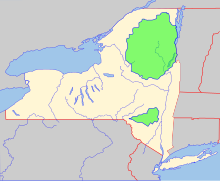
New York has many state parks and ii major woods preserves. The Adirondack Park, roughly the size of the state of Vermont and the largest state park in the United States, was established in 1892 and given state ramble protection in 1894.[6] The thinking that led to the creation of the park first appeared in George Perkins Marsh's Human and Nature, published in 1864. Marsh argued that deforestation could pb to desertification; referring to the clearing of once-lush lands surrounding the Mediterranean, he asserted "the operation of causes set up in action by man has brought the face of the earth to a pathos most every bit complete as that of the moon."[11]
The Catskill Park was protected in legislation passed in 1885, which declared that its state was to be conserved and never put upwardly for sale or charter. Consisting of 700,000 acres (ii,800 km2) of land, the park is a habitat for bobcats, minks and fishers with some 400 blackness bears living in the region. The state operates numerous campgrounds, and maintains over 300 miles (480 km) of multi-use trails. [12]
Encounter likewise [edit]
- Appalachia
- Glacial Lake Albany
References [edit]
- ^ "New York State Motto". New York Country Library. January 29, 2001. Archived from the original on May 24, 2009. Retrieved November xvi, 2007.
- ^ [1] Accessed October five, 2021.
- ^ "Marcy". NGS data canvass. U.S. National Geodetic Survey. Retrieved October xx, 2011.
- ^ a b "Elevations and Distances in the The states". U.s. Geological Survey. 2001. Archived from the original on February 1, 2009. Retrieved October 24, 2011.
- ^ a b Elevation adjusted to North American Vertical Datum of 1988.
- ^ a b "The Adirondack Park". NYS Adirondack Park Agency. 2003. Retrieved September 26, 2010.
- ^ "Land and Water Area of States (2000)". www.infoplease.com. Retrieved August 27, 2008.
- ^ Thomas Kaplan (December 17, 2014). "Citing Health Risks, Cuomo Bans Fracking in New York Land". New York Times.
- ^ a b c d e f g h i j k l m n o p q r French, John Homer (1860). Historical and statistical gazetteer of New York State. Syracuse, New York: R. Pearsall Smith. pp. nineteen–23. OCLC 224691273.
- ^ Geography of New York State:Lakes
- ^ * Full Text of Man Of Nature from the Library of Congress
- ^ http://world wide web.dec.ny.gov/lands/5265.html Archived Nov 10, 2018, at the Wayback Machine "Catskill Forest Preserve"
External links [edit]
-
 Media related to Geography of New York (state) at Wikimedia Commons
Source: https://en.wikipedia.org/wiki/Geography_of_New_York_(state)

Post a Comment for "what two rivers flow together to make the chemung river in ny state"